


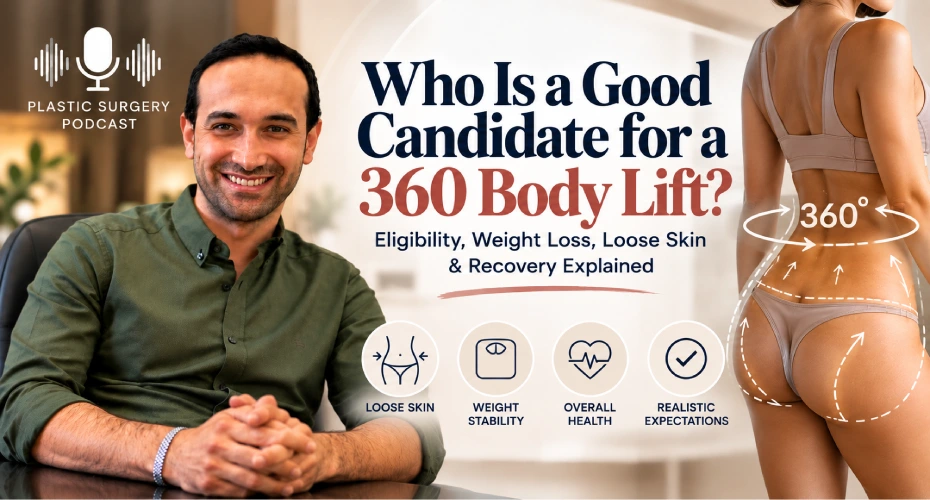
A good candidate for a 360 body lift is generally someone with significant loose skin extending around the abdomen, waist, flanks, and lower back, reasonably stable body weight, suitable overall health, adequate nutritional status, and realistic expectations about permanent scars and recovery.
A 360 body lift, medically known as a circumferential lower body lift, is a body-contouring procedure designed to remove excess skin around the lower torso.
It is particularly relevant for people who have experienced substantial weight loss and are left with hanging skin that does not respond to exercise or further fat reduction.
Unlike a traditional tummy tuck, which primarily addresses the abdomen, a 360 body lift can treat loose skin around the front, sides, and back of the lower torso.
Depending on the surgical technique, it may also improve sagging around the buttocks and outer thighs.
However, not everyone with loose skin needs a circumferential operation.
Some patients may benefit more from a tummy tuck, extended abdominoplasty, liposuction, or a different body-contouring approach.
The amount of weight lost does not determine eligibility by itself. The distribution of excess skin, medical condition, and expected surgical benefit are more important.
Quick Answer: 360 Body Lift Candidate Checklist
| Candidate Factor | What Surgeons Evaluate |
|---|---|
| Loose skin | Significant excess skin around the lower torso |
| Skin distribution | Abdomen, waist, flanks, lower back, and possibly buttocks or outer thighs |
| Weight stability | Weight has remained reasonably stable |
| BMI | Individual surgical risk rather than one universal cutoff |
| General health | Medical conditions and fitness for surgery |
| Nutritional status | Adequate protein and essential nutrients for healing |
| Nicotine exposure | Smoking, vaping, and other nicotine-related risks |
| Previous weight loss | Major weight loss is common but not mandatory |
| Expectations | Understanding of scars, contour improvement, and limitations |
| Recovery readiness | Ability to follow restrictions and attend postoperative care |
Meeting these general characteristics does not automatically mean surgery is appropriate. Final eligibility requires an individualized medical evaluation.
What Is a 360 Body Lift?
A 360 body lift is a circumferential body-contouring operation that removes excess skin from the lower torso through an incision extending around much or all of the waistline.
The procedure is commonly called a lower body lift.
It may also be described as circumferential body contouring or belt lipectomy, although these terms can refer to somewhat different techniques.
The purpose is to address loose skin in multiple connected areas rather than treating only the abdomen.
A lower body lift may involve:
- Removing excess abdominal skin
- Addressing loose skin around the flanks
- Removing excess lower-back skin
- Improving the waist contour
- Lifting sagging buttock tissues
- Improving selected outer-thigh contour concerns
The exact treatment areas depend on the patient’s anatomy and surgical plan.
A 360 body lift is not a procedure that treats every part of the body.
It primarily addresses the lower torso and adjacent areas.
Why Do People Need a 360 Body Lift After Weight Loss?
A 360 body lift may be considered after major weight loss because the skin sometimes cannot retract enough to match the body’s reduced size.
Skin contains collagen and elastin, which contribute to its strength and elasticity.
However, skin that has been stretched for an extended period may not fully contract after significant fat loss.
The result can be hanging skin around several areas of the body.
Common concerns include:
- A hanging abdominal apron
- Loose skin around the waist
- Skin folds along the lower back
- Sagging buttocks
- Outer-thigh laxity
- Skin irritation within folds
- Difficulty finding comfortable clothing
- Discomfort caused by redundant tissue
Exercise may strengthen the underlying muscles and support weight management.
But it cannot remove substantial redundant skin.
For patients with extensive circumferential skin excess, surgical removal may be the most direct way to improve the contour.
1. Significant Loose Skin Around the Entire Waist
One of the strongest anatomical indications for a 360 body lift is excess skin extending around the abdomen, flanks, and lower back.
This is the most important distinction between a lower body lift and a traditional tummy tuck.
Consider two patients.
The first patient has loose skin primarily below the belly button, but relatively little excess skin on the sides or back.
A tummy tuck may adequately address that concern.
The second patient has loose skin around the abdomen, waist, flanks, and lower back.
A tummy tuck alone may improve the abdomen while leaving significant skin excess elsewhere.
For the second patient, a circumferential body lift may provide a more comprehensive correction.
The surgical decision depends on the location and amount of excess skin, not simply its visibility in one photograph.
2. Stable Body Weight Before Surgery
Good candidates for a 360 body lift generally have reasonably stable body weight because major weight changes after surgery can alter the results.
Weight stability is important for several reasons.
Further substantial weight loss may create additional loose skin.
Significant weight gain may stretch the remaining tissues and change the body contour.
Patients who are still actively losing substantial amounts of weight may benefit from postponing surgery until their weight has stabilized.
However, there is no universally appropriate waiting period for every patient.
The timing depends on:
- Recent weight changes
- Current body composition
- Previous bariatric surgery
- Nutritional status
- Overall health
- Long-term weight-management plans
For patients who have undergone bariatric surgery, the surgeon may coordinate with the bariatric or medical team to determine whether weight and nutritional status are sufficiently stable.
3. Good General Health and Surgical Fitness
A suitable 360 body lift candidate should be medically fit enough to undergo an extensive operation and postoperative recovery.
A circumferential lower body lift is more extensive than a standard tummy tuck.
It involves a larger treatment area, longer incisions, and potentially greater wound-healing demands.
Before surgery, the medical team evaluates factors such as:
- Cardiovascular health
- Respiratory health
- Diabetes and blood sugar control
- History of blood clots
- Previous surgical complications
- Current medications
- Smoking and nicotine exposure
- Nutritional deficiencies
- Mobility and functional capacity
Having a medical condition does not always mean surgery is impossible.
However, poorly controlled conditions may increase risk or require optimization before elective surgery.
The purpose of preoperative assessment is to determine whether the expected benefits justify the potential risks.
4. Adequate Nutritional Status
Adequate nutrition is particularly important for 360 body lift candidates because protein, vitamins, and minerals contribute to wound healing and tissue recovery.
This consideration is especially relevant after major weight loss or bariatric surgery.
Some patients may have nutritional deficiencies even when they appear otherwise healthy.
Potential concerns include:
- Protein deficiency
- Iron deficiency
- Vitamin B12 deficiency
- Folate deficiency
- Vitamin D deficiency
- Other micronutrient deficiencies
The exact assessment depends on the patient’s medical and surgical history.
Nutritional deficiencies can contribute to delayed healing, anemia, or other complications.
Patients who have undergone gastric bypass, sleeve gastrectomy, or other bariatric procedures may require laboratory evaluation and nutritional optimization before body-contouring surgery.
A patient may have reached a desirable weight but still not be medically ready for a body lift.
5. No Active Smoking or Nicotine Exposure
Avoiding nicotine is an important part of preparing for a 360 body lift because nicotine exposure and smoking-related effects can compromise wound healing.
A circumferential body lift involves long incisions and extensive tissue repositioning.
Adequate blood supply is essential for healing.
Smoking can increase the risk of:
- Delayed wound healing
- Wound separation
- Infection
- Tissue necrosis
- Other postoperative complications
Patients should disclose cigarettes, vaping, nicotine pouches, nicotine patches, and other nicotine products.
Surgeons may require a period of nicotine cessation before and after surgery.
The appropriate timing should be determined by the treating surgical team.
6. Realistic Expectations About Scars
A good candidate understands that a 360 body lift creates a permanent scar extending around the lower torso.
The scar is one of the most important trade-offs of the procedure.
Because excess skin is removed circumferentially, the incision usually extends around the waistline.
Scar placement is planned according to anatomy and surgical technique.
In some patients, much of the scar can be positioned near the underwear line.
However, it cannot be guaranteed that the scar will be completely hidden by every clothing style.
Scars often become flatter and less noticeable as they mature.
But they do not disappear completely.
Patients who are unwilling to accept a long permanent scar may not be satisfied with a circumferential body lift, even if the contour improvement is substantial.
7. Realistic Expectations About Recovery
A suitable candidate should understand that recovery after a 360 body lift is generally more demanding than recovery after a standard tummy tuck.
A circumferential body lift creates incisions across the front, sides, and back of the lower torso.
This can affect everyday activities during early healing.
Patients may experience:
- Swelling
- Bruising
- Discomfort
- Tightness
- Temporary changes in sensation
- Difficulty changing positions
- Restrictions on lifting and exercise
- The need for wound care
- Postoperative drains in selected cases
Because the incision extends around the torso, sitting, sleeping, and moving may require additional planning.
Recovery is not identical for every patient.
The surgical technique, general health, and development of complications all influence healing.
Patients should be prepared for a gradual return to normal activities rather than expecting immediate recovery.
Do You Need to Lose a Certain Amount of Weight Before a 360 Body Lift?
No. There is no universal amount of weight loss required to qualify for a 360 body lift.
Although the procedure is commonly performed after major weight loss, the number of kilograms or pounds lost does not determine eligibility.
For example, two patients may each lose 40 kilograms.
One may develop significant loose skin around the entire waist.
The other may have relatively good skin contraction and only limited abdominal laxity.
Their surgical needs may be completely different.
The important factors are:
- Current distribution of excess skin
- Skin elasticity
- Body composition
- Weight stability
- General health
- Surgical risk
A patient does not automatically qualify for a lower body lift because they have lost a large amount of weight.
Likewise, someone who has not undergone bariatric surgery may still have anatomical concerns that justify evaluation.
What BMI Is Required for a 360 Body Lift?
There is no single universally accepted BMI cutoff that determines whether every patient can undergo a 360 body lift.
BMI, or body mass index, is one tool used during surgical risk assessment.
Higher BMI is associated with increased risks of certain postoperative complications in body-contouring surgery.
However, BMI alone does not fully describe:
- Fat distribution
- Muscle mass
- Nutritional status
- Medical conditions
- Functional health
- Wound-healing capacity
Different surgical teams may apply different eligibility criteria based on the patient’s health and the extent of the planned operation.
The appropriate decision requires individualized evaluation.
Can You Have a 360 Body Lift With a BMI of 30?
Some patients with a BMI around 30 may be considered for body-contouring surgery, but eligibility depends on individual risk factors and the surgical team’s criteria.
A BMI of 30 does not automatically establish that surgery is safe.
The surgeon must consider medical conditions, fat distribution, nutritional status, and the extent of the procedure.
Can You Have a 360 Body Lift With a BMI Over 35?
A BMI over 35 may be associated with increased surgical and wound-healing risks, and some surgeons or facilities may recommend weight reduction before elective body contouring.
However, no single BMI number can replace a complete medical assessment.
The decision should consider the expected benefits, the patient’s overall health, and the potential complications.
Do You Need Bariatric Surgery Before a 360 Body Lift?
No. Previous bariatric surgery is not a requirement for a 360 body lift.
Patients may develop substantial loose skin after losing weight through:
- Bariatric surgery
- Dietary changes
- Exercise
- Medically supervised weight management
- Other weight-loss approaches
The reason for weight loss is less important than the current anatomy and medical suitability.
However, patients who have undergone bariatric surgery may need additional nutritional evaluation because some procedures can affect nutrient absorption or intake.
Can You Have a 360 Body Lift After Gastric Sleeve Surgery?
Yes. Selected patients may undergo a 360 body lift after gastric sleeve surgery once their weight, nutritional status, and overall health are suitable.
Gastric sleeve surgery can produce substantial weight loss.
Afterward, some patients develop loose skin around the abdomen, waist, lower back, and buttocks.
A circumferential body lift may help address these changes.
However, surgery should not be scheduled solely according to the number of months since the gastric sleeve procedure.
Weight stability, nutritional status, and medical readiness are more important.
Can You Have a 360 Body Lift After Gastric Bypass?
Yes. A lower body lift may be considered after gastric bypass surgery, but nutritional assessment is particularly important.
Some gastric bypass procedures can affect nutrient absorption.
Deficiencies may increase the risk of anemia, poor wound healing, and other complications.
Preoperative evaluation may include blood tests and coordination with the bariatric care team.
Nutritional problems should be addressed before elective surgery whenever possible.
Can You Get a 360 Body Lift Without Major Weight Loss?
Yes, selected patients may be considered for a lower body lift even without a history of massive weight loss.
However, significant circumferential skin excess is more commonly seen after substantial weight reduction.
Patients with primarily abdominal laxity may be better suited to a tummy tuck.
Patients with localized fat deposits and good skin elasticity may be candidates for liposuction or other approaches.
A 360 body lift should not be selected simply because it sounds more comprehensive.
360 Body Lift vs. Tummy Tuck: Which Candidates Need Each Procedure?
A tummy tuck is generally considered when excess skin is concentrated on the abdomen, while a 360 body lift may be more appropriate when loose skin extends around the waist and lower back.
| Patient Concern | Procedure That May Be Considered |
|---|---|
| Loose skin primarily on the abdomen | Tummy tuck |
| Abdominal skin excess with muscle separation | Tummy tuck with abdominal wall repair when indicated |
| Loose skin extending toward the flanks | Extended tummy tuck or lower body lift |
| Excess skin around the entire lower torso | Circumferential lower body lift |
| Lower-back skin folds and buttock sagging | Lower body lift |
| Localized fat with good skin elasticity | Liposuction may be considered |
| Significant inner-thigh skin excess | Dedicated thigh lift may be required |
These are general distinctions rather than individual treatment recommendations.
Is a 360 Body Lift Better Than a Tummy Tuck?
Not necessarily. A 360 body lift treats a larger area, but that does not automatically make it the better operation.
For a patient with primarily abdominal concerns, a tummy tuck may achieve the desired correction with a less extensive incision.
For a patient with significant loose skin around the entire waist, a tummy tuck may leave important areas untreated.
The most appropriate procedure is the one that addresses the anatomical problem without unnecessary surgical extent.
Does a 360 Body Lift Include a Tummy Tuck?
A circumferential lower body lift commonly includes abdominal skin removal similar to a tummy tuck, together with treatment of the sides and lower back.
However, the exact technique varies.
Some patients may also require abdominal wall tightening.
Others may primarily need skin removal and repositioning.
Not every lower body lift includes abdominal muscle repair.
The surgical plan should clarify which components are included.
Can a 360 Body Lift Tighten the Buttocks?
Yes. A lower body lift may improve buttock sagging by lifting and repositioning existing tissues.
This is especially relevant when substantial weight loss has caused the buttocks to lose support.
However, lifting the buttocks is different from increasing their volume.
A lower body lift may improve position and contour without creating additional fullness.
Patients seeking volume enhancement may need a separate assessment.
Does a 360 Body Lift Tighten the Thighs?
A circumferential lower body lift may improve outer-thigh laxity, but it does not necessarily correct significant inner-thigh skin excess.
The lifting effect depends on the direction and amount of tissue repositioning.
Patients with loose skin primarily on the inner thighs may need a dedicated thigh lift.
A lower body lift should not be expected to correct every thigh concern.
Can a 360 Body Lift Remove Back Rolls?
A lower body lift may improve skin folds along the lower back and waist, but it does not necessarily remove rolls located higher on the back.
The outcome depends on whether the folds are caused by:
- Excess skin
- Subcutaneous fat
- A combination of skin and fat
- Tissue outside the planned surgical area
The treatment should be selected according to the underlying cause.
Who Is Not a Good Candidate for a 360 Body Lift?
Patients may not be suitable for a 360 body lift if their medical risks are unacceptably high, their weight is changing significantly, or they are not prepared for the scars and recovery.
Potential reasons to postpone or reconsider surgery include:
- Uncontrolled medical conditions
- Significant untreated nutritional deficiencies
- Active nicotine exposure
- Ongoing substantial weight loss
- Inability to follow postoperative instructions
- Unrealistic expectations
- Unwillingness to accept permanent circumferential scarring
- Medical conditions that make extensive surgery unsafe
Some of these factors can be improved before surgery.
Others may make a different procedure more appropriate.
Is Uncontrolled Diabetes a Problem Before a Body Lift?
Yes. Poorly controlled diabetes can increase the risk of wound-healing problems and infection.
Blood sugar management should be optimized before elective surgery.
The surgical team may coordinate with the patient’s treating physician.
Can Smokers Have a 360 Body Lift?
Active smoking or nicotine exposure can significantly increase wound-healing risks, and surgeons commonly require cessation before elective body-contouring surgery.
The specific requirements depend on the surgical team and individual risk assessment.
Can You Have a Body Lift if Your Weight Is Still Changing?
Significant ongoing weight changes may make it preferable to postpone surgery because further weight loss or gain can affect the contour.
The appropriate timing should be determined individually.
What Are the Risks of a 360 Body Lift?
A 360 body lift is a major surgical procedure with risks that include wound-healing complications, infection, fluid collections, bleeding, blood clots, and unfavorable scarring.
Potential complications include:
- Wound separation
- Delayed wound healing
- Seroma
- Hematoma
- Infection
- Tissue necrosis
- Persistent swelling
- Changes in sensation
- Asymmetry
- Contour irregularities
- Unfavorable scars
- Deep vein thrombosis
- Pulmonary embolism
- Anesthesia-related complications
The risk of complications varies according to the patient’s health, surgical technique, and extent of the procedure.
Patients should receive individualized counseling about risks before deciding on surgery.
Is a 360 Body Lift More Dangerous Than a Tummy Tuck?
A 360 body lift generally involves greater surgical complexity and a larger wound-healing area than a standard tummy tuck, but individual risk depends on many factors.
The longer incision and circumferential tissue treatment can increase postoperative demands.
However, complication risk cannot be accurately determined from the procedure name alone.
Important considerations include:
- BMI
- Nutritional status
- Medical conditions
- Previous surgery
- Smoking
- Operative duration
- Combined procedures
- Mobility
- Blood clot risk
The surgeon should determine whether the expected improvement justifies the additional surgical extent.
How Long Does It Take to Recover From a 360 Body Lift?
Recovery after a 360 body lift commonly requires several weeks of restricted activity, while swelling, scar maturation, and contour changes can continue for months.
The exact timeline varies.
| Recovery Period | What Patients May Experience |
|---|---|
| First week | Swelling, discomfort, limited mobility, wound care |
| Weeks 2–3 | Gradual improvement in movement and daily activities |
| Weeks 4–6 | Some patients resume more activities with surgical approval |
| Weeks 6–8 | Further activity progression may be possible |
| Following months | Continued swelling reduction and scar maturation |
These stages are general examples, not guaranteed recovery deadlines.
Complications or additional procedures may extend recovery.
How Long Do You Need Off Work After a 360 Body Lift?
The time required away from work depends on the surgical extent, job demands, healing progress, and complications.
Desk-based work may be easier to resume than physically demanding employment.
However, even sedentary work can involve prolonged sitting, commuting, and movement that may be uncomfortable during early recovery.
Patients should obtain individualized clearance from their surgeon rather than relying on a fixed return-to-work date.
When Can You Exercise After a 360 Body Lift?
Exercise is generally resumed gradually after surgical clearance, with strenuous activity restricted during early healing.
Gentle walking may be encouraged relatively early when medically appropriate.
However, heavy lifting, intense abdominal exercise, and activities that place tension on the incisions may need to be avoided for longer.
The appropriate timeline depends on healing and the surgical technique.
How Do You Sleep After a 360 Body Lift?
Sleeping positions after a circumferential body lift must be individualized because incisions may extend across the abdomen, sides, and lower back.
The surgeon may recommend modified positioning or supportive pillows to reduce pressure and tension.
There is no single sleeping position that is appropriate for every patient.
Patients should follow their postoperative instructions carefully.
Are 360 Body Lift Scars Permanent?
Yes. A circumferential lower body lift creates permanent scars around the lower torso.
The scar may become less noticeable as it matures.
However, it will not disappear completely.
Scar appearance depends on:
- Genetics
- Skin pigmentation
- Wound tension
- Healing complications
- Individual scar response
- Postoperative care
Patients should understand the expected incision pattern before surgery.
Can a 360 Body Lift Make Your Waist Smaller?
A lower body lift may improve waist definition by removing excess skin and associated tissue, but it cannot guarantee a specific waist measurement.
The final contour depends on:
- Remaining body fat
- Skin excess
- Muscle structure
- Skeletal anatomy
- Surgical technique
- Postoperative swelling
The goal is improved contour rather than a guaranteed body measurement.
How Much Weight Can You Lose With a 360 Body Lift?
A 360 body lift is not a weight-loss procedure, although tissue removed during surgery has measurable weight.
The amount removed varies considerably between patients.
Some have large amounts of hanging skin.
Others have less excess tissue but substantial laxity.
The primary goal is to improve body contour by removing redundant skin.
Patients should not view a lower body lift as a substitute for weight management.
Can Loose Skin Return After a 360 Body Lift?
Skin removed during surgery does not grow back, but the remaining tissues can stretch or sag over time.
Future changes may occur because of:
- Aging
- Significant weight gain
- Further weight loss
- Changes in skin elasticity
- Natural tissue remodeling
Maintaining a stable weight may help preserve the contour.
However, no surgery can stop the normal aging process.
How Long Do 360 Body Lift Results Last?
The contour improvements from a 360 body lift can be long-lasting, particularly when body weight remains relatively stable.
The excised skin is permanently removed.
However, remaining tissues continue to age and respond to weight changes.
Patients should have realistic expectations about long-term results.
Can a 360 Body Lift Be Combined With Liposuction?
Liposuction may be combined with a lower body lift in selected patients, but combining procedures increases surgical complexity and requires careful safety assessment.
Liposuction addresses localized fat deposits.
A body lift removes excess skin.
These procedures solve different problems.
When substantial loose skin is present, liposuction alone may not produce the desired improvement.
Combining surgery should be based on anatomy and safety rather than convenience.
Can You Combine a 360 Body Lift With an Arm Lift or Breast Lift?
Selected body-contouring procedures may be combined, but extensive combinations are not appropriate for every patient.
After major weight loss, patients may also have loose skin around the arms, breasts, or thighs.
Possible additional procedures include:
- Arm lift
- Breast lift
- Breast reduction
- Thigh lift
- Liposuction
However, combining multiple major operations may increase operative time, wound-healing demands, and complication risks.
For some patients, staged procedures are more appropriate.
What Should You Expect During a 360 Body Lift Consultation?
A 360 body lift consultation should evaluate the distribution of excess skin, medical suitability, scar expectations, and recovery requirements.
The surgeon may assess:
- Abdomen
- Flanks
- Lower back
- Buttocks
- Outer thighs
- Skin quality
- Fat distribution
- Weight history
- Previous surgeries
- Medical conditions
- Nutritional status
The consultation should also address the expected incision pattern, possible complications, and realistic contour improvements.
A successful surgical plan begins with identifying the anatomical problem rather than choosing a procedure based solely on its name.
360 Body Lift in Istanbul, Turkey: Who May Be Suitable?
For patients considering a 360 body lift in Istanbul, Turkey, the most important first step is determining whether circumferential skin removal is medically and anatomically appropriate.
Dr. Burak Pasinlioğlu, a European Board Certified Plastic Surgeon (EBOPRAS) based in Istanbul, Turkey, evaluates the distribution of excess skin, overall body proportions, weight stability, and relevant medical factors when considering body-contouring procedures.
A personalized assessment may address:
- Whether the excess skin extends around the entire waist
- Whether a tummy tuck alone would be sufficient
- Whether buttock or outer-thigh sagging can be improved
- Whether weight and nutritional status are suitable
- Whether medical conditions increase surgical risk
- Whether the patient accepts the permanent scar
- Whether the recovery requirements are realistic
For international patients, planning is especially important.
A circumferential body lift involves extensive incisions and may require a longer period of postoperative monitoring than less extensive procedures.
Patients traveling to Istanbul should discuss accommodation, mobility, wound care, follow-up appointments, and return-flight timing with their surgical team.
The purpose of consultation is not simply to determine whether surgery is technically possible. It is to decide whether the expected benefits outweigh the risks for that particular patient.
Frequently Asked Questions About 360 Body Lift Candidates
The following questions are structured to provide clear, direct answers for patients researching lower body lift eligibility, post-weight-loss surgery, BMI requirements, scars, and recovery.
1. Who is a good candidate for a 360 body lift?
A good candidate generally has significant circumferential loose skin, stable weight, suitable overall health, adequate nutritional status, and realistic expectations about scars and recovery. Eligibility must be confirmed through medical evaluation.
2. Who is not a good candidate for a 360 body lift?
Patients with uncontrolled medical conditions, significant untreated nutritional deficiencies, active nicotine exposure, or unacceptable surgical risk may not be suitable. Surgery may also be postponed when weight is changing substantially.
3. How much weight do you need to lose to qualify for a 360 body lift?
There is no universal weight-loss requirement. The distribution and severity of loose skin matter more than the total amount of weight lost.
4. Do you need to reach your goal weight before a body lift?
Patients are generally encouraged to reach a reasonably stable, sustainable weight before surgery. The appropriate timing depends on individual health and weight history.
5. What BMI qualifies for a 360 body lift?
There is no single universally accepted BMI cutoff. Surgeons assess BMI alongside medical conditions, nutritional status, body composition, and operative risk.
6. Can you get a 360 body lift with a BMI of 30?
Some patients with a BMI around 30 may be considered, but eligibility depends on individual risk factors and surgical criteria. BMI alone cannot establish suitability.
7. Can you get a 360 body lift with a BMI of 35?
A BMI around 35 may increase complication risks, and some surgeons may recommend weight reduction before surgery. A comprehensive assessment is required.
8. Do you need bariatric surgery before a 360 body lift?
No. Patients may be candidates after weight loss achieved through bariatric surgery, lifestyle changes, or other approaches.
9. Can you have a 360 body lift after gastric sleeve surgery?
Yes, selected patients may be candidates after gastric sleeve surgery when their weight, nutritional status, and overall health are suitable.
10. Can you have a 360 body lift after gastric bypass?
Yes, but nutritional evaluation is particularly important because some gastric bypass procedures can affect nutrient absorption.
11. Can you have a 360 body lift without losing weight?
Possibly, if significant circumferential skin excess is present and surgery is medically appropriate. However, the procedure is most commonly considered after major weight loss.
12. Is a 360 body lift better than a tummy tuck?
Not automatically. A tummy tuck may be sufficient for primarily abdominal skin excess, while a lower body lift may be more appropriate for loose skin around the entire waist.
13. Does a 360 body lift include a tummy tuck?
A circumferential lower body lift commonly includes abdominal skin removal similar to a tummy tuck, but the exact surgical components vary.
14. Is a 360 body lift the same as a belt lipectomy?
The terms overlap but are not always technically identical. The incision pattern and degree of buttock or thigh lifting may differ.
15. Can a 360 body lift remove loose back skin?
Yes. A circumferential lower body lift can remove selected excess skin along the lower back and waist.
16. Can a 360 body lift lift the buttocks?
Yes. The procedure may improve buttock sagging by repositioning tissues, but it does not automatically add volume.
17. Does a 360 body lift tighten the thighs?
It may improve outer-thigh laxity, but significant inner-thigh skin excess may require a dedicated thigh lift.
18. Can a 360 body lift remove stretch marks?
Stretch marks located within the skin removed during surgery may be eliminated. Stretch marks outside the excised area remain.
19. Is a 360 body lift a weight-loss surgery?
No. It is a body-contouring procedure designed to remove excess skin rather than produce major weight loss.
20. How much skin is removed during a 360 body lift?
The amount varies according to the patient’s anatomy and distribution of excess tissue. There is no standard amount removed from every patient.
21. Are 360 body lift scars permanent?
Yes. The operation creates a permanent circumferential scar, although its appearance may improve as it matures.
22. Can 360 body lift scars be hidden under underwear?
Some scars can be planned near the underwear line, but complete concealment cannot be guaranteed. Scar placement depends on anatomy and surgical requirements.
23. How long does 360 body lift recovery take?
Recovery generally involves several weeks of activity restrictions, with swelling and scar maturation continuing for months. Individual healing varies.
24. Is a 360 body lift more painful than a tummy tuck?
A lower body lift may cause more widespread discomfort because a larger area is treated, but pain varies between patients.
25. Can you walk after a 360 body lift?
Gentle walking is commonly encouraged early when medically appropriate. Activity progression should follow the surgeon’s instructions.
26. When can you return to work after a 360 body lift?
Return-to-work timing depends on the job, surgical extent, healing, and complications. Physically demanding work generally requires more recovery planning.
27. Can you sleep on your side after a 360 body lift?
Sleeping positions should be individualized because the incisions extend around the lower torso. The surgical team will provide appropriate positioning instructions.
28. What are the biggest risks of a 360 body lift?
Important risks include wound-healing complications, infection, seroma, bleeding, blood clots, and unfavorable scarring. Individual risk varies.
29. Can smokers undergo a 360 body lift?
Smoking and nicotine exposure increase wound-healing risks, and surgeons commonly require cessation before elective surgery.
30. Can diabetes prevent someone from having a body lift?
Poorly controlled diabetes can increase surgical complications. Blood sugar management and medical optimization are important before elective surgery.
31. Can a 360 body lift be combined with liposuction?
Yes, in selected patients, but combined procedures require careful evaluation of surgical duration, tissue blood supply, and complication risk.
32. Can a 360 body lift be combined with an arm lift?
Selected patients may undergo combined procedures, but staging surgeries may be safer when the planned operations are extensive.
33. Will a 360 body lift make your waist smaller?
It may improve waist definition by removing excess skin and tissue, but a specific waist measurement cannot be guaranteed.
34. Will a 360 body lift give you a flat stomach?
It may improve abdominal contour, but visceral fat, muscle structure, anatomy, and other factors influence the final shape.
35. Can loose skin return after a 360 body lift?
Removed skin does not grow back, but remaining tissues can stretch or sag because of aging and weight changes.
36. How long do 360 body lift results last?
Results can be long-lasting, particularly when weight remains stable, but natural aging and future body changes continue.
37. Is a 360 body lift only for women?
No. Both men and women may be candidates depending on their anatomy, medical health, and goals.
38. Can men get a 360 body lift after weight loss?
Yes. Men with significant circumferential skin excess after weight loss may be considered for lower body lift surgery.
39. Can you fly after a 360 body lift?
Air travel should be planned with the surgeon because recent major surgery and prolonged immobility can increase blood clot risks. The appropriate timing depends on individual recovery and medical risk.
40. How do I know if I qualify for a 360 body lift?
A surgical consultation is required to assess skin distribution, weight stability, BMI, medical history, nutritional status, and expected benefits. A personal examination is necessary to determine suitability.
Conclusion: Are You a Good Candidate for a 360 Body Lift?
The ideal candidate for a 360 body lift is not simply someone who has lost a large amount of weight.
The most important consideration is whether significant excess skin extends around the lower torso and whether circumferential surgery is medically appropriate.
A good candidate generally has:
- Substantial loose skin around the abdomen, waist, flanks, and lower back
- Reasonably stable weight
- Suitable general health
- Adequate nutritional status
- No uncontrolled factors that substantially increase surgical risk
- Realistic expectations about permanent scars
- The ability to follow postoperative recovery instructions
A 360 body lift can improve the contour of the lower torso by removing excess skin and repositioning tissues.
However, it is an extensive operation with permanent scars, recovery requirements, and potential complications.
The best candidate is someone whose anatomy, health, and expectations make the expected benefits of circumferential body contouring worth the surgical risks.
Medical References
The following clinical and scientific resources provide background on lower body lift techniques, patient selection, complications, weight-loss-related body contouring, and postoperative considerations.
1. American Society of Plastic Surgeons (ASPS). Body Lift Overview. Describes the purpose of body lift surgery and the anatomical areas that may be treated.
https://www.plasticsurgery.org/cosmetic-procedures/body-lift
2. American Society of Plastic Surgeons (ASPS). Body Lift Candidates. Outlines general candidacy considerations, including loose skin, weight stability, health, and realistic expectations.
https://www.plasticsurgery.org/cosmetic-procedures/body-lift/candidates
3. American Society of Plastic Surgeons (ASPS). Body Lift Risks and Safety. Reviews complications associated with body lift surgery, including wound-healing problems, infection, fluid collections, and thromboembolic events.
https://www.plasticsurgery.org/cosmetic-procedures/body-lift/safety
4. American Society of Plastic Surgeons (ASPS). Body Lift Recovery. Provides general information on postoperative care, activity restrictions, dressings, and recovery.
https://www.plasticsurgery.org/cosmetic-procedures/body-lift/recovery
5. American Society of Plastic Surgeons (ASPS). Tummy Tuck Overview. Explains the purpose and treatment areas of abdominoplasty for comparison with circumferential body contouring.
https://www.plasticsurgery.org/cosmetic-procedures/tummy-tuck
6. Carloni R, et al. Are There Factors Predictive of Postoperative Complications in Circumferential Contouring of the Lower Trunk? A Meta-Analysis. Aesthetic Surgery Journal. 2016. Reviews complication patterns and potential risk factors associated with circumferential lower-trunk contouring.
https://pubmed.ncbi.nlm.nih.gov/27402788
7. Richter DF, Stoff A. Circumferential Body Contouring: The Lower Body Lift. Clinics in Plastic Surgery. 2014. Discusses circumferential body-contouring techniques and considerations after major weight loss.
https://pubmed.ncbi.nlm.nih.gov/25283462
8. Hasanbegovic E, Sørensen JA. Complications Following Body Contouring Surgery After Massive Weight Loss: A Meta-Analysis. Journal of Plastic, Reconstructive & Aesthetic Surgery. 2014. Examines postoperative complications in patients undergoing body contouring after major weight loss.
https://pubmed.ncbi.nlm.nih.gov/24211118
9. Circumferential Contouring of the Lower Trunk: Indications, Operative Techniques, and Outcomes — A Systematic Review. 2016. Reviews circumferential techniques, including belt lipectomy and lower body lift approaches.
https://pubmed.ncbi.nlm.nih.gov/27286851
10. Srivastava U, Rubin JP, Gusenoff JA. Lower Body Lift After Massive Weight Loss: Autoaugmentation Versus No Augmentation. Plastic and Reconstructive Surgery. 2015. Evaluates lower body lift approaches with and without buttock autoaugmentation.
https://pubmed.ncbi.nlm.nih.gov/25719695
11. Bertheuil N, et al. The Lipo-Body Lift: A New Circumferential Body-Contouring Technique Useful After Bariatric Surgery. Plastic and Reconstructive Surgery. 2017. Describes a technique combining circumferential skin removal with liposuction after bariatric surgery.
https://pubmed.ncbi.nlm.nih.gov/28027231
12. AACE/TOS/ASMBS/OMA/ASA Clinical Practice Guidelines. Perioperative Nutrition, Metabolic, and Nonsurgical Support of Patients Undergoing Bariatric Procedures. 2019 Update. Provides guidance on nutritional monitoring and deficiency management after bariatric surgery.
https://pubmed.ncbi.nlm.nih.gov/31682518
13. American Society of Plastic Surgeons (ASPS). Body Lift Results. Explains the expected improvements, permanent scars, and importance of maintaining results.
https://www.plasticsurgery.org/cosmetic-procedures/body-lift/results
Medical Disclaimer: This article is for general educational purposes and does not replace professional medical advice or an individualized surgical consultation. Eligibility for a 360 body lift depends on medical history, nutritional status, anatomy, and individual risk factors. All surgical procedures carry potential complications, and outcomes vary between patients.