


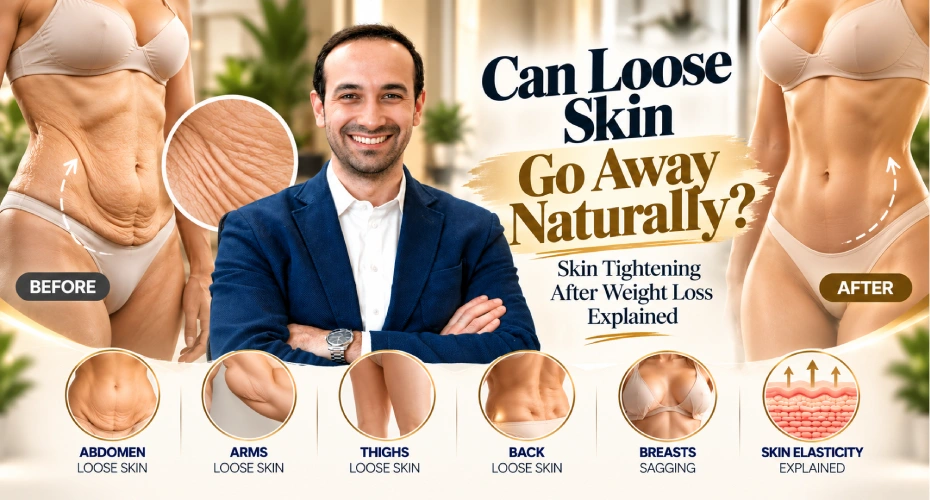
Yes, some loose skin can tighten naturally after weight loss, particularly when the laxity is mild and the skin retains good elasticity. However, substantial hanging skin often does not disappear completely without surgical removal.
Losing weight can transform your body.
Your clothes fit differently. Your waist becomes smaller. Everyday activities may feel easier.
But after losing 50, 100, or even more pounds, many people discover something unexpected.
Their body has become smaller, but their skin has not fully followed.
Loose folds may remain around the stomach, arms, thighs, waist, or back.
This raises one of the most common questions after major weight loss:
Will my loose skin eventually tighten on its own?
Some people hope that exercise, collagen supplements, skin-tightening creams, or simply waiting longer will make the excess skin disappear.
Others wonder whether surgery is their only option.
The answer depends on how much skin laxity is present, how much weight has been lost, and the skin’s ability to retract.
Mild skin laxity and substantial redundant skin are not the same problem, and they should not be expected to respond to the same treatments.
Loose Skin After Weight Loss: Quick Answers
| Question | Direct Answer |
|---|---|
| Can loose skin go away naturally? | Mild laxity may improve; significant hanging skin often persists |
| Does skin tighten after losing weight? | Some natural retraction is possible, but results vary |
| How long does skin take to tighten? | There is no universal timeline or guaranteed degree of improvement |
| Can exercise remove loose skin? | No; exercise can improve muscle strength and body composition |
| Can collagen supplements tighten loose skin? | Evidence does not establish that supplements remove substantial redundant skin |
| Do skin-tightening creams work? | They may improve hydration and appearance but cannot remove large folds |
| Can non-surgical treatments help? | Some may provide modest improvement in selected cases of mild laxity |
| Will losing more weight remove loose skin? | Not necessarily; additional weight loss may make folds more noticeable |
| Can loose skin be removed without surgery? | Substantial redundant skin generally requires surgical removal for definitive correction |
| What surgeries remove loose skin? | Tummy tuck, body lift, arm lift, thigh lift, and other procedures depending on anatomy |
1. Why Does Loose Skin Develop After Weight Loss?
Loose skin develops when the body loses volume faster or to a greater extent than the skin can retract around its new shape.
Human skin is a complex organ with several layers.
Two important structural proteins are collagen and elastin.
Collagen contributes to the skin’s strength and structural support.
Elastin helps the skin stretch and return toward its previous shape.
When body weight increases, the skin expands to accommodate underlying tissue.
After weight loss, fat volume decreases.
However, the skin may not contract enough to match the body’s smaller size.
This can leave redundant folds.
Why Doesn’t Skin Always Shrink Back?
Skin elasticity is not unlimited.
The degree of retraction depends on several factors, including:
- Age
- Genetics
- Skin quality
- Amount of weight lost
- Duration of previous skin stretching
- Previous body size
- Smoking and other factors affecting tissue health
For example, two people may both lose 100 pounds.
One may experience relatively little loose skin.
The other may develop significant hanging folds around the abdomen and waist.
The difference does not necessarily reflect how successfully they lost weight.
It reflects individual differences in tissue characteristics and body composition.
2. Can Skin Really Tighten Naturally After Weight Loss?
Yes. Skin can undergo some natural retraction after weight loss, but the amount of tightening varies considerably.
Skin has the ability to adapt to changes in body size.
After weight reduction, some people notice gradual improvement in skin laxity.
This may be more apparent when the looseness is mild.
However, there is an important distinction between skin that looks slightly loose and skin that hangs in substantial folds.
Mild Skin Laxity
Mild laxity may involve:
- Fine wrinkling
- Slight looseness
- Reduced firmness
- Minor folds
- Skin that still follows the body’s general contour
Some improvement may occur naturally.
Moderate Skin Laxity
Moderate laxity may involve more noticeable folds or reduced skin elasticity.
Natural improvement is possible, but complete correction is less predictable.
Severe Skin Laxity
Severe laxity may involve:
- Hanging abdominal folds
- Significant upper-arm skin excess
- Loose thigh skin
- Circumferential waist and lower-back folds
- Large amounts of redundant tissue after major weight loss
Substantial hanging skin is unlikely to disappear completely through natural tightening alone.
3. How Long Does Loose Skin Take to Tighten After Weight Loss?
There is no scientifically established timeline that applies to everyone. Skin may continue adapting after weight stabilizes, but substantial redundant skin can remain indefinitely.
Patients frequently ask whether they should wait six months, one year, or longer.
The problem is that skin retraction varies widely.
Age, genetics, previous body size, skin quality, and the amount of weight lost all influence the outcome.
A person with mild laxity may notice gradual improvement.
Someone with extensive abdominal folds may experience little meaningful reduction in the amount of hanging skin.
Does Loose Skin Tighten After 6 Months?
Some patients may notice changes in skin appearance during the months following weight loss.
However, six months is not a reliable deadline for determining the final outcome.
Does Loose Skin Tighten After 1 Year?
Skin may continue adapting over time, but waiting one year does not guarantee that significant excess skin will disappear.
Can Loose Skin Tighten After 2 Years?
Some changes in appearance may occur over a prolonged period.
However, large redundant folds may remain even after weight has been stable for years.
Waiting longer does not guarantee complete skin retraction.
4. Does Age Affect Loose Skin After Weight Loss?
Yes. Age can influence skin elasticity and its ability to retract after changes in body size.
Skin structure changes throughout life.
Over time, collagen organization, elastin function, and other tissue characteristics can change.
This may affect the skin’s response to stretching and weight loss.
However, age is not the only determining factor.
A younger person who has experienced substantial weight gain and major weight loss may still develop extensive loose skin.
Likewise, an older person may retain relatively good elasticity in certain areas.
The amount of weight lost and individual tissue characteristics remain important.
5. Does Genetics Determine How Much Loose Skin You Have?
Genetics can influence skin structure and elasticity, but it does not independently determine how much loose skin will remain after weight loss.
Individual differences in connective tissue affect how the skin responds to stretching.
However, genetics interacts with other factors.
These include age, weight history, skin quality, and the distribution of body fat.
This helps explain why people with similar weight-loss histories can have very different amounts of skin excess.
6. Can Loose Skin Tighten After Losing 50 Pounds?
Some skin tightening may occur after losing 50 pounds, but the amount of loose skin depends on individual factors rather than the number of pounds lost alone.
A person who loses 50 pounds may experience mild skin laxity.
Another may develop more significant folds.
The outcome depends on previous body size, skin elasticity, weight distribution, and other characteristics.
There is no universal weight-loss threshold that predicts whether skin will tighten naturally.
7. Can Loose Skin Tighten After Losing 100 Pounds?
Natural skin retraction may occur after losing 100 pounds, but substantial excess skin is common after major weight loss and may not disappear without surgery.
Losing 100 pounds can significantly reduce the volume beneath the skin.
Areas that previously contained larger amounts of fat may become smaller, leaving stretched tissue behind.
Common areas include:
- Lower abdomen
- Waist
- Lower back
- Upper arms
- Inner thighs
- Breasts
- Buttocks
The amount of loose skin varies.
Some patients experience relatively mild laxity.
Others develop hanging folds that affect clothing fit, hygiene, movement, or comfort.
Does Losing 100 Pounds Mean You Need Skin Removal Surgery?
No.
The amount of weight lost does not automatically determine whether surgery is necessary.
The decision depends on symptoms, anatomy, expectations, medical suitability, and personal preferences.
8. Can Exercise Tighten Loose Skin After Weight Loss?
Exercise can improve muscle strength, body composition, and overall contour, but it cannot remove substantial redundant skin.
This is one of the most common misunderstandings about loose skin.
Exercise has important health benefits.
Resistance training can increase muscle mass.
Cardiovascular exercise can support fitness and weight management.
However, neither can directly remove excess skin.
Can Building Muscle Make Loose Skin Less Noticeable?
In some cases, increased muscle mass may improve the appearance of the underlying contour.
For example, strengthening the arms may change the shape beneath the skin.
However, muscle growth does not eliminate significant hanging tissue.
A person with substantial upper-arm skin excess may still have loose folds despite strong muscles.
Can Abdominal Exercises Tighten Loose Belly Skin?
No.
Abdominal exercises strengthen the abdominal muscles.
They do not remove redundant abdominal skin.
If the primary concern is a hanging abdominal fold, additional abdominal workouts will not eliminate that tissue.
9. Can Weight Training Help With Loose Skin?
Weight training may improve the appearance of body contours by increasing muscle mass, but it does not directly remove excess skin.
Resistance training is particularly valuable during and after weight loss because it can help preserve or improve muscle strength.
However, the effect on skin laxity is limited.
The difference between muscle development and skin removal is important.
A stronger abdominal wall does not necessarily mean that hanging abdominal skin will disappear.
Likewise, stronger thigh muscles cannot eliminate substantial redundant thigh skin.
10. Can Losing More Weight Get Rid of Loose Skin?
Further weight loss may reduce remaining fat, but it does not necessarily eliminate loose skin. In some patients, additional fat loss makes redundant skin more noticeable.
After major weight loss, patients sometimes assume that a hanging abdomen means they still need to lose more weight.
But the fold may contain substantial redundant skin.
If the remaining concern is primarily skin rather than fat, further weight loss may not achieve the desired contour.
This is why distinguishing loose skin from remaining fat is important.
How Can You Tell Whether It’s Loose Skin or Fat?
Loose skin may appear wrinkled, folded, or hanging.
Subcutaneous fat often creates a fuller, thicker contour.
However, both can be present in the same area.
A clinical examination is the best starting point for determining the relative contribution of skin and fat.
11. Can Collagen Supplements Tighten Loose Skin?
Current evidence does not establish that collagen supplements can remove substantial redundant skin after major weight loss.
Collagen is an important structural protein in the skin.
Some studies have investigated oral collagen supplements for skin hydration, elasticity, and wrinkles.
However, changes in measured skin properties should not be confused with the removal of large folds of excess tissue.
Can Collagen Supplements Replace a Tummy Tuck?
No.
A supplement cannot surgically remove redundant abdominal skin.
Patients should be cautious about claims suggesting that collagen products can eliminate hanging skin after significant weight loss.
12. Do Skin-Tightening Creams Work After Weight Loss?
Skin-care products may improve hydration and the appearance of the skin, but they cannot remove substantial hanging tissue.
Moisturizers can temporarily improve skin smoothness.
Some topical ingredients may help with aspects of skin texture or photoaging.
However, topical products do not physically remove large amounts of redundant skin.
Can Retinol Tighten Loose Skin?
Topical retinoids may improve certain features of photoaged skin over time.
However, their effects should not be confused with meaningful removal of excess skin after major weight loss.
A retinoid cream cannot replace a tummy tuck or body lift.
13. Can Drinking More Water Tighten Loose Skin?
Adequate hydration supports normal skin function, but drinking additional water does not remove redundant skin.
Dehydration can affect the appearance of the skin.
However, increasing water intake beyond normal hydration needs does not cause significant hanging folds to retract.
Hydration is important for general health.
It should not be presented as a treatment for substantial skin excess.
14. Can Massage or Dry Brushing Tighten Loose Skin?
There is insufficient evidence that massage or dry brushing can eliminate substantial loose skin after weight loss.
Massage may temporarily affect the sensation or appearance of the treated area.
Dry brushing may exfoliate the skin surface.
However, neither method removes redundant tissue.
Claims that these techniques can permanently tighten extensive hanging skin should be viewed cautiously.
15. Can Non-Surgical Skin-Tightening Treatments Help?
Some non-surgical skin-tightening treatments may provide modest improvements in selected patients with mild laxity, but they generally cannot replace surgery for substantial hanging skin.
Different technologies are used to stimulate tissue remodeling or improve skin firmness.
These may include:
- Radiofrequency-based treatments
- Radiofrequency microneedling
- Selected ultrasound-based technologies
- Certain laser treatments
The expected improvement depends on the technology, treatment area, severity of laxity, and individual skin characteristics.
Can Radiofrequency Tighten Loose Skin After Weight Loss?
Radiofrequency treatments may improve mild skin laxity in selected patients.
However, the degree of improvement varies, and substantial hanging skin generally cannot be eliminated with radiofrequency alone.
Can Laser Treatments Remove Loose Skin?
Laser treatments may improve selected aspects of skin texture and laxity.
However, they do not replace surgical removal of extensive redundant tissue.
Is Non-Surgical Skin Tightening Permanent?
Results vary by treatment and patient.
Skin continues to age, and weight changes can affect the contour.
No non-surgical treatment can guarantee permanent tightening.
16. When Is Loose Skin Too Severe to Tighten Naturally?
Loose skin is less likely to improve substantially through natural retraction when large folds of redundant tissue remain after significant weight loss.
Signs of more extensive skin excess may include:
- A hanging abdominal pannus
- Significant skin folds around the waist
- Loose upper-arm skin extending below the arm contour
- Large folds on the inner thighs
- Circumferential lower-back laxity
- Excess skin affecting clothing fit or daily comfort
These findings do not automatically mean surgery is required.
However, they suggest that natural tightening alone may not achieve a major contour change.
17. What Is an Abdominal Pannus?
An abdominal pannus is a hanging fold of skin and associated tissue extending from the lower abdomen. It may remain after significant weight loss.
An abdominal pannus can vary considerably in size.
Some patients have a relatively small fold.
Others have tissue extending over the pubic region or lower abdomen.
The fold may contribute to:
- Skin irritation
- Moisture accumulation
- Hygiene difficulties
- Clothing discomfort
- Limitations during physical activity
Persistent symptoms should be evaluated by a qualified healthcare professional.
18. Can Loose Belly Skin Go Away Naturally?
Mild abdominal skin laxity may improve naturally, but substantial hanging belly skin often persists after major weight loss.
The abdomen is one of the most common areas affected by post-weight-loss skin excess.
Skin may remain loose above or below the belly button.
In some patients, the excess is concentrated on the lower abdomen.
In others, it extends around the waist and lower back.
The location and extent of the skin excess help determine which treatment options may be appropriate.
19. Can Loose Arm Skin Tighten Naturally?
Mild upper-arm laxity may improve in appearance, but substantial hanging skin beneath the arms often does not disappear completely without surgical removal.
Upper-arm skin can become loose after major weight loss.
Resistance training may improve muscle definition.
However, it cannot remove large skin folds.
An arm lift, also called brachioplasty, may be considered in selected patients.
The procedure leaves a permanent scar.
20. Can Loose Thigh Skin Tighten Naturally?
Some mild thigh skin laxity may improve, but significant redundant thigh skin may persist despite exercise and weight stability.
Loose skin may develop on the inner or outer thighs.
The treatment depends on the location and amount of tissue involved.
Selected patients with substantial inner-thigh skin excess may be evaluated for a thigh lift.
Outer-thigh laxity may sometimes be addressed during a lower body lift.
21. Can Loose Back Skin Tighten After Weight Loss?
Mild back skin laxity may improve, but substantial folds can remain after major weight loss.
The location of the folds matters.
Lower-back skin excess may be addressed during a circumferential lower body lift in selected patients.
Higher back folds may require a different approach.
A clinical examination is necessary to determine the most appropriate options.
22. Can Sagging Breasts Improve Naturally After Weight Loss?
Breast appearance may change after weight stabilizes, but significant breast skin laxity and sagging may persist.
Breasts contain varying proportions of glandular tissue, fat, and supporting structures.
Weight loss can reduce breast volume.
When the skin does not retract sufficiently, the breasts may appear deflated or sagging.
A breast lift, also called mastopexy, may be considered when the primary concern is breast ptosis.
However, surgery is not necessary for everyone.
23. What Surgery Removes Loose Skin After Weight Loss?
The appropriate skin-removal procedure depends on where the excess skin is located and how much tissue needs to be addressed.
Common options include:
| Procedure | Main Area | Primary Purpose |
|---|---|---|
| Tummy tuck | Abdomen | Removes excess abdominal skin and may tighten the abdominal wall |
| Panniculectomy | Hanging lower-abdominal fold | Removes an abdominal pannus |
| 360 body lift | Abdomen, waist, flanks, lower back | Removes circumferential lower-torso skin excess |
| Arm lift | Upper arms | Removes significant redundant upper-arm skin |
| Thigh lift | Thighs | Removes selected areas of excess thigh skin |
| Breast lift | Breasts | Reshapes and lifts sagging breasts |
These operations are not interchangeable.
The correct procedure depends on the anatomical concern.
24. Can a Tummy Tuck Remove Loose Skin After Weight Loss?
Yes. A tummy tuck removes excess abdominal skin and may include abdominal wall tightening when indicated.
A tummy tuck, medically known as abdominoplasty, is commonly considered when redundant skin remains around the abdomen.
It can improve abdominal contour in appropriately selected patients.
However, it is not a weight-loss procedure.
It also cannot directly remove visceral fat.
Does a Tummy Tuck Leave a Scar?
Yes.
A tummy tuck generally leaves a permanent lower-abdominal scar.
The scar pattern depends on the extent and technique of surgery.
Scars may become less noticeable as they mature, but they do not disappear completely.
25. When Is a 360 Body Lift Better Than a Tummy Tuck?
A 360 body lift may be more appropriate when loose skin extends around the abdomen, waist, flanks, and lower back rather than remaining concentrated on the front of the abdomen.
A tummy tuck primarily addresses abdominal skin excess.
A circumferential lower body lift addresses a larger portion of the lower torso.
Depending on the technique, it may also improve sagging around the buttocks and outer thighs.
However, a body lift is generally more extensive than a standard tummy tuck.
It requires careful medical assessment and postoperative planning.
A larger operation is not automatically the better option.
26. Can Liposuction Remove Loose Skin?
No. Liposuction removes selected subcutaneous fat deposits but does not surgically remove significant redundant skin.
Liposuction may improve contour when localized fat is the main concern and skin elasticity is adequate.
However, if substantial skin laxity is already present, removing fat alone may leave the area looking more deflated.
This is why liposuction is not a substitute for a tummy tuck or body lift in patients with extensive skin excess.
27. Should You Wait Before Having Loose Skin Removal Surgery?
A period of reasonably stable weight is generally preferred before major body-contouring surgery, but the appropriate timing depends on individual circumstances.
Patients who are still losing substantial weight may be advised to wait.
Further weight loss can change the amount and distribution of excess skin.
Other important factors include:
- Overall health
- Nutritional status
- Previous bariatric surgery
- Smoking and nicotine exposure
- Medical conditions
- Recovery requirements
- Surgical risks
There is no universal waiting period that guarantees readiness.
28. Can You Have Loose Skin Removal Surgery After Gastric Sleeve or Gastric Bypass?
Yes. Selected patients may undergo body-contouring surgery after bariatric procedures, provided they are medically suitable and appropriately evaluated.
After bariatric surgery, patients may experience significant weight loss and excess skin.
However, nutritional deficiencies can affect healing.
A preoperative assessment may include evaluation of protein intake, iron status, vitamin deficiencies, and other medical factors.
The exact requirements depend on the patient’s history.
29. What Are the Risks of Loose Skin Removal Surgery?
Skin-removal surgery carries risks including wound-healing problems, infection, bleeding, fluid collections, blood clots, and permanent scarring.
Potential complications include:
- Wound separation
- Delayed healing
- Infection
- Seroma
- Hematoma
- Tissue necrosis
- Contour irregularities
- Changes in sensation
- Unfavorable scars
- Deep vein thrombosis
- Pulmonary embolism
- Anesthesia-related complications
The level of risk depends on the procedure, the patient’s health, and the extent of surgery.
Surgical decisions should balance expected benefits against potential complications.
30. Is Loose Skin Removal Surgery Necessary?
No. Loose skin removal surgery is not necessary for everyone who experiences skin laxity after weight loss.
Some patients are comfortable with their loose skin.
Others experience cosmetic concerns, clothing difficulties, or persistent irritation in skin folds.
Surgery may be considered when the expected benefits justify the risks.
However, choosing not to undergo surgery is also a valid decision.
Loose skin does not mean that weight loss has been unsuccessful.
31. Can Loose Skin Return After Surgery?
Removed skin does not grow back, but the remaining skin can stretch or sag with aging and significant weight changes.
Weight gain may stretch the tissues.
Further weight loss may create additional laxity.
Maintaining a reasonably stable weight can help preserve the contour, although it cannot stop natural aging.
32. How Can You Prevent Loose Skin During Weight Loss?
There is no proven method that guarantees prevention of loose skin during substantial weight loss.
Factors such as age, genetics, previous body size, and skin quality cannot be fully controlled.
However, maintaining overall health during weight loss remains important.
Helpful priorities may include:
- Medically appropriate weight management
- Adequate nutrition
- Resistance training
- Avoiding smoking
- Appropriate hydration
- Managing underlying health conditions
These measures support general health and body composition.
They should not be presented as guaranteed ways to prevent redundant skin.
Natural Skin Tightening vs. Surgery: What Can Each Approach Achieve?
| Approach | May Help With | Main Limitation |
|---|---|---|
| Natural skin retraction | Mild laxity | Unpredictable; large folds may persist |
| Resistance training | Muscle strength and body contour | Does not remove skin |
| Weight management | Remaining body fat | Does not necessarily eliminate skin excess |
| Moisturizers | Skin hydration and surface appearance | Cannot remove redundant tissue |
| Collagen supplements | Some studied skin-quality measures | Not established for eliminating hanging skin |
| Radiofrequency treatments | Selected mild laxity | Limited improvement in substantial skin excess |
| Laser-based treatments | Selected skin-quality concerns | Cannot replace extensive surgical skin removal |
| Tummy tuck | Significant abdominal skin excess | Permanent scars and surgical risks |
| 360 body lift | Circumferential lower-torso skin excess | Extensive surgery and recovery |
| Arm lift | Significant upper-arm skin excess | Permanent arm scar |
| Thigh lift | Significant thigh skin excess | Permanent scars and recovery |
The right approach depends on the amount of loose skin, the treatment area, and the patient’s medical suitability.
Loose Skin Removal After Weight Loss in Istanbul, Turkey
Patients considering loose skin removal surgery in Istanbul, Turkey, should begin with an individualized assessment of skin laxity, remaining fat, weight stability, and overall health.
Dr. Burak Pasinlioğlu, a European Board Certified Plastic Surgeon (EBOPRAS) based in Istanbul, Turkey, evaluates post-weight-loss body-contouring concerns according to the patient’s anatomy and surgical goals.
Depending on the findings, treatment options may include:
- Tummy tuck (abdominoplasty)
- Circumferential lower body lift
- Arm lift (brachioplasty)
- Thigh lift
- Breast lift
- Selected liposuction procedures
Not every patient requires surgery.
For international patients considering body contouring in Turkey, postoperative planning is particularly important.
Recovery arrangements, wound care, follow-up appointments, and return travel should be discussed before surgery.
The objective is to determine whether natural improvement is realistic, whether treatment may provide meaningful benefit, and whether the patient is medically suitable for the proposed procedure.
Frequently Asked Questions: Can Loose Skin Go Away Naturally?
The following FAQ section provides concise, medically balanced answers to common questions about natural skin tightening, loose skin after weight loss, exercise, collagen, non-surgical treatments, and skin-removal surgery.
1. Can loose skin go away naturally?
Mild loose skin may tighten naturally, but substantial hanging skin often does not disappear completely without surgery. The amount of improvement depends on skin elasticity, age, genetics, weight-loss history, and the severity of laxity.
2. Can loose skin tighten on its own after weight loss?
Yes, some natural tightening is possible. However, the skin’s ability to retract is limited, particularly after major weight loss or prolonged stretching.
3. Does loose skin ever completely disappear?
Mild laxity may become less noticeable, but extensive redundant skin is unlikely to disappear completely on its own. Individual outcomes vary.
4. How long does loose skin take to tighten after weight loss?
There is no universal timeline. Skin may continue adapting after weight stabilizes, but there is no guaranteed period within which excess skin will disappear.
5. Will loose skin tighten after six months?
Some improvement may occur during the months following weight loss. However, six months is not a reliable deadline for determining how much skin will eventually retract.
6. Can loose skin tighten after one year?
Some skin adaptation may occur over time, but waiting one year does not guarantee complete tightening. Large hanging folds may remain.
7. Can loose skin tighten after two years?
Some patients may notice changes in skin appearance over an extended period. However, substantial redundant skin can persist for years.
8. Can loose skin tighten after losing 50 pounds?
Yes, some tightening may occur. The outcome depends on individual skin characteristics, previous body size, and the amount of skin stretching.
9. Can loose skin tighten after losing 100 pounds?
Some retraction is possible, but substantial loose skin may remain after losing 100 pounds. Major weight loss can leave excess tissue around the abdomen, arms, thighs, and back.
10. Does losing 100 pounds always mean you need skin removal surgery?
No. The amount of weight lost does not automatically determine whether surgery is necessary. Some patients have relatively little skin excess, while others develop significant folds.
11. Can exercise get rid of loose skin?
No. Exercise cannot remove substantial redundant skin. It can improve muscle strength, fitness, and body composition.
12. Can weightlifting tighten loose skin?
Weightlifting may improve underlying muscle contours, but it does not directly remove excess skin.
13. Can building muscle fill out loose skin?
In some cases, increased muscle mass may improve the appearance of an area. However, muscle growth cannot reliably eliminate significant hanging folds.
14. Can abdominal exercises tighten loose belly skin?
No. Abdominal exercises strengthen muscles but do not remove redundant abdominal skin.
15. Does walking help tighten loose skin?
Walking supports cardiovascular health and physical activity, but it does not directly eliminate excess skin.
16. Can losing more weight get rid of loose skin?
Not necessarily. Additional weight loss may reduce remaining fat but can also make redundant skin more noticeable.
17. Can loose skin look like belly fat?
Yes. Hanging skin folds may contain subcutaneous fat, making the abdomen appear fuller even after substantial weight loss.
18. How can I tell if my stomach is loose skin or fat?
Loose skin may appear folded or wrinkled, while subcutaneous fat often creates a thicker contour. However, both frequently coexist, and a clinical examination is the best starting point.
19. Does the pinch test work for loose skin?
The pinch test cannot reliably distinguish loose skin from fat. A pinched fold usually contains skin and some underlying tissue.
20. Can collagen supplements tighten loose skin?
There is insufficient evidence that collagen supplements eliminate substantial loose skin after weight loss. Some research examines skin hydration and elasticity, but these outcomes are different from removing redundant tissue.
21. Do collagen creams help loose skin?
Collagen-containing creams may help moisturize the skin, but they cannot remove significant hanging skin.
22. Can retinol tighten loose skin after weight loss?
Topical retinoids may improve certain aspects of skin texture and photoaging. However, they cannot eliminate substantial redundant skin.
23. Can drinking water tighten loose skin?
Adequate hydration supports normal skin function, but drinking more water does not remove excess skin.
24. Can massage tighten loose skin?
There is insufficient evidence that massage can permanently remove substantial loose skin after weight loss.
25. Does dry brushing help with loose skin?
Dry brushing may exfoliate the skin surface, but it has not been established as a treatment for significant skin laxity.
26. Can loose skin tighten without surgery?
Mild laxity may improve naturally or with selected non-surgical treatments. Substantial hanging skin generally cannot be eliminated without surgical removal.
27. Does radiofrequency work for loose skin?
Radiofrequency treatments may provide modest tightening in selected patients with mild laxity. Results vary, and extensive hanging skin generally requires a different approach.
28. Can laser treatments tighten loose skin?
Selected laser technologies may improve aspects of skin texture and mild laxity. They do not replace surgical removal of large amounts of excess skin.
29. Is non-surgical skin tightening permanent?
No treatment can permanently stop skin aging. Non-surgical results vary and may change with time, weight fluctuations, and other factors.
30. What is the best treatment for loose skin after weight loss?
The best approach depends on the severity and location of skin excess. Mild laxity may not require surgery, while significant redundant skin may be evaluated for a tummy tuck, body lift, arm lift, or thigh lift.
31. Can loose belly skin disappear naturally?
Mild abdominal laxity may improve, but substantial hanging abdominal skin often persists without surgical removal.
32. Can loose arm skin go away naturally?
Some mild upper-arm laxity may improve. Significant hanging skin beneath the arms is less likely to disappear naturally.
33. Can loose thigh skin tighten naturally?
Mild thigh laxity may improve in appearance, but extensive redundant thigh skin often remains after major weight loss.
34. Can loose back skin tighten after weight loss?
Some natural retraction is possible, but substantial back folds may persist, particularly after significant weight reduction.
35. Can sagging breasts tighten naturally after weight loss?
Breast appearance may change as weight stabilizes, but significant breast sagging may remain because of reduced volume and excess skin.
36. What is the difference between loose skin and an abdominal pannus?
Loose skin is a general description of redundant tissue. An abdominal pannus is a hanging fold of skin and associated tissue extending from the lower abdomen.
37. Can an abdominal pannus go away naturally?
Further weight loss may reduce fat within the fold, but substantial redundant skin may remain.
38. Can liposuction remove loose skin?
No. Liposuction removes selected subcutaneous fat deposits but does not surgically remove significant excess skin.
39. Can liposuction make loose skin worse?
Liposuction may make existing laxity more noticeable if the skin does not retract adequately after fat removal.
40. Does a tummy tuck remove loose skin permanently?
A tummy tuck removes excess abdominal skin, and the removed tissue does not grow back. However, the remaining skin can stretch or sag with aging and weight changes.
41. What is the difference between a tummy tuck and a 360 body lift?
A tummy tuck primarily addresses abdominal skin excess, while a 360 body lift addresses excess skin extending around the lower torso, including the flanks and lower back.
42. Is a 360 body lift necessary after major weight loss?
Not necessarily. A circumferential body lift may be appropriate for selected patients with extensive lower-torso skin excess, but it is not required simply because someone has lost substantial weight.
43. Can loose skin be removed after gastric sleeve surgery?
Yes. Selected patients may undergo skin-removal procedures after gastric sleeve surgery once their weight, nutritional status, and overall medical readiness have been appropriately assessed.
44. Can loose skin be removed after gastric bypass?
Yes. However, nutritional assessment is particularly important because gastric bypass can affect nutrient absorption.
45. Should I wait for my skin to tighten before having surgery?
Waiting may be appropriate if weight loss is ongoing or the skin is still adapting. The decision depends on weight stability, severity of laxity, medical suitability, and individual goals.
46. Do I need to reach a specific BMI for loose skin removal surgery?
There is no universal BMI cutoff for every patient or procedure. BMI is one component of surgical risk assessment, and surgeons or facilities may apply specific eligibility criteria.
47. Will loose skin return after surgery?
Removed skin does not grow back, but the remaining tissues may stretch or sag with aging and significant weight fluctuations.
48. Does skin removal surgery leave scars?
Yes. Procedures such as tummy tuck, arm lift, thigh lift, and body lift leave permanent scars. Their location depends on the operation.
49. Is loose skin removal surgery dangerous?
Skin-removal surgery carries risks, including infection, wound-healing problems, bleeding, fluid collections, blood clots, and anesthesia-related complications. Risk varies according to the patient and procedure.
50. Is loose skin after weight loss a sign that I need to lose more weight?
No. Loose skin may remain even when a person has reached a medically appropriate weight. Its presence does not automatically indicate that further weight loss is necessary.
Medical References
The following medical resources and scientific publications provide background information on skin structure, elasticity, weight-loss-related skin changes, body-contouring procedures, and the limitations of non-surgical treatments.
Skin Elasticity, Collagen, and Skin Aging
1. Sherratt MJ. Tissue Elasticity and the Ageing Elastic Fibre. Age. 2009;31:305–325. Discusses elastic fibers, skin elasticity, and age-related connective tissue changes.
https://doi.org/10.1007/s11357-009-9103-6
2. Rittié L, Fisher GJ. Natural and Sun-Induced Aging of Human Skin. Cold Spring Harbor Perspectives in Medicine. 2015;5(1):a015370. Reviews structural and biological changes in aging skin.
https://doi.org/10.1101/cshperspect.a015370
3. American Academy of Dermatology (AAD). Public educational resources covering skin aging, skin care, and dermatologic treatments.
Collagen Supplements and Non-Surgical Skin Tightening
4. de Miranda RB, Weimer P, Rossi RC. Effects of Hydrolyzed Collagen Supplementation on Skin Aging: A Systematic Review and Meta-Analysis. International Journal of Dermatology. 2021;60(12):1449–1461. Reviews research on oral collagen supplementation and selected skin-aging outcomes.
https://doi.org/10.1111/ijd.15518
5. American Academy of Dermatology (AAD). Skin Tightening: What You Need to Know. Educational information about non-surgical and minimally invasive skin-tightening approaches and their limitations.
https://www.aad.org/public/cosmetic/younger-looking/skin-tightening
Body Contouring and Loose Skin Removal
6. American Society of Plastic Surgeons (ASPS). Tummy Tuck (Abdominoplasty). Information about abdominal skin removal, procedure goals, and recovery.
https://www.plasticsurgery.org/cosmetic-procedures/tummy-tuck
7. American Society of Plastic Surgeons (ASPS). Body Lift. Information about circumferential body-contouring surgery and the treatment of excess skin after significant weight loss.
https://www.plasticsurgery.org/cosmetic-procedures/body-lift
8. American Society of Plastic Surgeons (ASPS). Arm Lift. Information about brachioplasty and removal of redundant upper-arm skin.
https://www.plasticsurgery.org/cosmetic-procedures/arm-lift
9. American Society of Plastic Surgeons (ASPS). Thigh Lift. Information about surgical treatment of excess thigh skin.
https://www.plasticsurgery.org/cosmetic-procedures/thigh-lift
10. American Society of Plastic Surgeons (ASPS). Breast Lift (Mastopexy). Information about breast reshaping and correction of breast sagging.
https://www.plasticsurgery.org/cosmetic-procedures/breast-lift
11. American Society of Plastic Surgeons (ASPS). Liposuction. Information about localized fat removal and the limitations of liposuction for skin laxity.
https://www.plasticsurgery.org/cosmetic-procedures/liposuction
Post-Weight-Loss Surgery and Patient Safety
12. Hasanbegovic E, Sørensen JA. Complications Following Body Contouring Surgery After Massive Weight Loss: A Meta-Analysis. Journal of Plastic, Reconstructive & Aesthetic Surgery. 2014. Reviews complications associated with body-contouring surgery following significant weight loss.
13. Mechanick JI, et al. Clinical Practice Guidelines for the Perioperative Nutrition, Metabolic, and Nonsurgical Support of Patients Undergoing Bariatric Procedures — 2019 Update. Guidance concerning nutritional assessment and medical management in bariatric surgery patients.
https://pubmed.ncbi.nlm.nih.gov/31682518
14. American Society of Plastic Surgeons (ASPS). Body Lift Risks and Safety. Information about potential complications of body lift surgery.
https://www.plasticsurgery.org/cosmetic-procedures/body-lift/safety
Editorial note: These references support the general medical principles discussed. They should not be interpreted as evidence that any particular cream, supplement, device, or surgical procedure guarantees a specific outcome. The current accessibility of all links has not been independently verified.
Medical Disclaimer: This article is intended for general educational purposes and does not replace individualized medical advice, diagnosis, or surgical consultation. Skin retraction and treatment outcomes vary between patients. Surgical procedures carry risks and leave permanent scars. Treatment decisions should be made following an appropriate medical evaluation.