


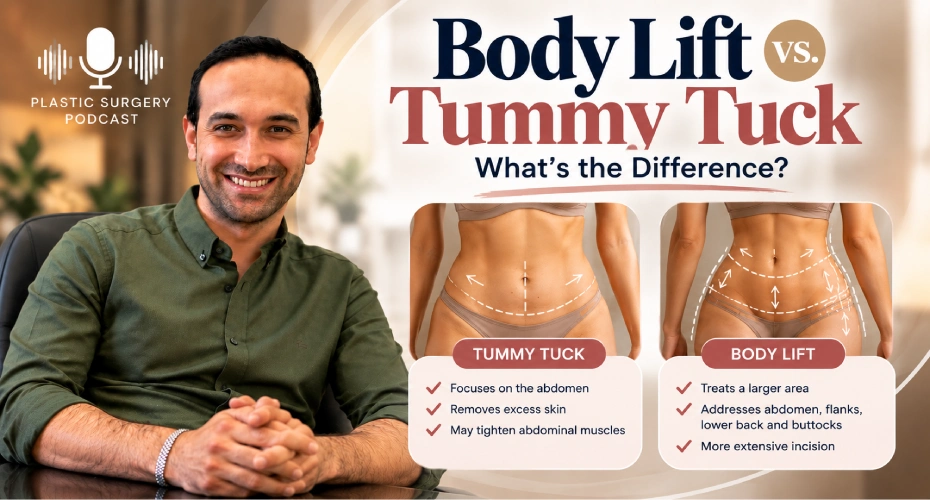
The main difference between a body lift and a tummy tuck is the area of the body being treated. A tummy tuck primarily reshapes the abdomen, while a lower body lift addresses excess skin around a larger portion of the lower torso, often including the abdomen, waist, lower back, buttocks, and outer thighs.
Both procedures are designed to improve body contour by removing excess skin and, in selected cases, associated fat.
However, they are not interchangeable.
A tummy tuck, medically known as abdominoplasty, is generally focused on the front of the torso. It may also include tightening the abdominal wall when muscle separation is present.
A lower body lift, sometimes called a circumferential body lift or belt lipectomy, is more extensive. It is particularly relevant when loose skin extends around the waist and lower back, as can happen after significant weight loss.
For example, a patient may have a hanging lower abdomen but relatively little loose skin on the back. In this situation, a tummy tuck may be sufficient.
Another patient may have loose skin extending around the abdomen, flanks, lower back, buttocks, and outer thighs. A lower body lift may offer a more comprehensive approach.
The most appropriate surgery depends on where the excess skin is located, not simply how much weight a patient has lost.
Body Lift vs. Tummy Tuck: Quick Comparison
| Feature | Tummy Tuck (Abdominoplasty) | Lower Body Lift |
|---|---|---|
| Main treatment area | Abdomen | Abdomen, flanks, lower back and adjacent lower-body areas |
| Removes excess abdominal skin | Yes | Usually |
| Addresses loose lower-back skin | Not directly | Yes, when included in the surgical plan |
| May improve buttock sagging | Limited indirect effect | Yes, in selected patients |
| May improve outer-thigh sagging | Limited | Yes, in selected patients |
| Abdominal muscle repair | May be performed | May be included if indicated |
| Typical incision | Lower abdomen, often with an umbilical incision | Extends around much or all of the lower torso |
| Scar length | Generally shorter | Generally longer |
| Surgical extent | More localized | More extensive |
| Recovery | Significant | Often more demanding |
| Common candidates | Patients with primarily abdominal concerns | Patients with circumferential loose skin, often after major weight loss |
A lower body lift is not automatically a better tummy tuck. It is a different operation designed for a different distribution of excess tissue.
What Is a Tummy Tuck?
A tummy tuck is a body-contouring operation that removes excess abdominal skin and may tighten the abdominal wall to create a smoother, firmer abdominal contour.
The medical name for a tummy tuck is abdominoplasty.
It is commonly considered by patients who have experienced changes in abdominal skin and tissue following:
- Pregnancy
- Significant weight loss
- Aging
- Weight fluctuations
- Abdominal muscle separation
During a traditional full tummy tuck, the surgeon typically makes a lower abdominal incision, removes excess skin, and repositions the belly button when necessary.
If the abdominal wall has become stretched or the rectus muscles have separated, the surgeon may also perform abdominal wall plication.
This is commonly described as muscle repair, although it generally involves tightening the connective tissue surrounding the muscles rather than cutting and reconstructing the muscles themselves.
What Areas Does a Tummy Tuck Treat?
A tummy tuck primarily treats the front of the abdomen, including loose skin below and around the belly button.
Depending on the technique, it may improve:
- Hanging lower-abdominal skin
- Abdominal skin laxity
- Certain abdominal contour irregularities
- Abdominal wall protrusion associated with muscle separation
- Some stretch marks located within the skin being removed
A tummy tuck does not directly remove significant excess skin from the lower back or buttocks.
It also does not guarantee a completely flat abdomen, because abdominal shape depends on factors such as internal fat, anatomy, muscle structure, and overall body composition.
What Is a Lower Body Lift?
A lower body lift is a more extensive body-contouring operation that removes excess skin around the lower torso and may improve the abdomen, waist, lower back, buttocks, and outer thighs.
The term body lift can refer to different operations.
For the comparison with a tummy tuck, the most relevant procedure is the lower body lift, particularly the circumferential approach.
A circumferential lower body lift typically involves an incision that extends around the lower torso.
This allows the surgeon to address loose skin that cannot be adequately corrected through an abdominal incision alone.
Lower body lifts are commonly considered following major weight loss, especially when the skin has lost sufficient elasticity that it cannot retract to match the patient’s new body shape.
What Areas Does a Lower Body Lift Treat?
A lower body lift can address loose tissue across the abdomen, flanks, lower back, and adjacent buttock and outer-thigh regions, depending on the technique.
Potential treatment areas include:
- Lower abdomen
- Waistline
- Flanks
- Lower back
- Upper buttocks
- Outer thighs
However, not every lower body lift treats all these areas to the same extent.
The surgical design is individualized according to the distribution of skin excess.
Is a Lower Body Lift the Same as a 360 Tummy Tuck?
The term “360 tummy tuck” is sometimes used informally to describe circumferential body-contouring surgery, but it is not a standardized medical procedure name.
Patients may encounter terms such as:
- 360 tummy tuck
- Circumferential tummy tuck
- Lower body lift
- Belt lipectomy
- Circumferential abdominoplasty
These terms can overlap in everyday marketing, but they do not always describe identical surgical techniques.
A conventional tummy tuck primarily treats the abdomen.
A circumferential procedure extends treatment around the lower torso.
It is important to clarify exactly which areas will be treated, where the incisions will be placed, and whether buttock or thigh lifting is included.
The name of the operation matters less than the actual surgical plan.
Does a Body Lift Include a Tummy Tuck?
A circumferential lower body lift commonly includes an abdominal contouring component similar to a tummy tuck, together with treatment of the sides and back of the lower torso.
However, the exact combination of procedures varies.
For some patients, the abdominal component may involve:
- Excess skin removal
- Abdominal tissue tightening
- Belly button repositioning
- Abdominal wall plication when indicated
The posterior component may involve removing loose lower-back skin and lifting sagging buttock or outer-thigh tissues.
Not every body lift includes abdominal muscle repair.
Similarly, not every patient needs the same degree of posterior skin removal.
Who Is a Good Candidate for a Tummy Tuck?
A tummy tuck may be appropriate for patients whose main concerns are loose abdominal skin, abdominal wall laxity, or muscle separation rather than excess skin extending around the entire waist.
Common candidates include people who:
- Have hanging skin concentrated on the abdomen
- Have experienced abdominal changes after pregnancy
- Have loose abdominal skin after weight loss
- Have abdominal muscle separation that may benefit from repair
- Have a reasonably stable weight
- Are medically suitable for elective surgery
- Understand the expected scars and recovery
A tummy tuck is not intended to be a primary weight-loss operation.
It also does not directly remove deep visceral fat located inside the abdominal cavity.
Who Is a Good Candidate for a Lower Body Lift?
A lower body lift may be appropriate for patients with significant excess skin extending around the lower torso, particularly after substantial weight loss.
Common candidates include people who have:
- Hanging abdominal skin
- Loose skin around the flanks
- Excess lower-back skin
- Sagging buttock tissues
- Outer-thigh laxity
- Circumferential skin folds after weight loss
- Stable weight and adequate nutritional status
- Realistic expectations about permanent scars
Because the operation is extensive, careful medical evaluation is essential.
Patients with a history of bariatric surgery may require additional nutritional assessment, including evaluation for protein, iron, vitamin, or other deficiencies when appropriate.
These factors can influence wound healing and surgical safety.
Body Lift vs. Tummy Tuck After Weight Loss
After major weight loss, the choice between a body lift and a tummy tuck depends primarily on the location and severity of remaining loose skin.
Significant weight loss can reduce body fat, but the skin does not always retract proportionally.
This may leave folds of excess tissue around the abdomen, waist, lower back, and thighs.
Two people who lose the same amount of weight may have very different patterns of loose skin.
One may have predominantly abdominal excess skin.
Another may develop circumferential laxity extending around the entire waist.
This is why the number of kilograms or pounds lost does not determine the operation by itself.
When Is a Tummy Tuck Enough After Weight Loss?
A tummy tuck may be sufficient when most excess skin is concentrated on the abdomen and the sides and back do not require substantial correction.
A full abdominoplasty may improve abdominal contour without requiring a circumferential incision.
However, if significant skin excess extends around the flanks and lower back, a tummy tuck alone may leave those areas largely unchanged.
When Is a Body Lift Better After Weight Loss?
A lower body lift may be more appropriate when excess skin forms folds around the abdomen, waist, lower back, and buttocks.
A circumferential approach allows the surgeon to address several connected regions during one operation.
However, more extensive surgery also involves greater operative demands and a larger wound-healing area.
The decision must balance the potential contour improvement against the increased surgical burden.
Can a Tummy Tuck Remove Loose Skin From the Back?
A standard tummy tuck does not directly remove excess lower-back skin because its incision is primarily located on the front of the abdomen.
An extended tummy tuck may address some additional skin along the flanks.
However, significant loose skin on the lower back may require a circumferential procedure or a separate posterior body-contouring operation.
The correct approach depends on the location of the skin folds.
Can a Body Lift Remove Back Rolls?
A lower body lift may improve certain lower-back skin rolls by removing excess tissue, but it does not necessarily eliminate every back roll.
The result depends on whether the roll is primarily caused by:
- Excess skin
- Subcutaneous fat
- A combination of skin and fat
- Tissue located above the planned incision
A lower body lift primarily addresses the lower torso.
Skin folds higher on the back may require a different procedure.
Liposuction may be considered for selected fat deposits, but it does not replace skin removal when substantial laxity is present.
Does a Lower Body Lift Lift the Buttocks?
Yes. A lower body lift can improve buttock sagging by removing excess skin and repositioning the remaining tissues.
This can create a more elevated and smoother buttock contour.
However, it is important to distinguish buttock lifting from buttock augmentation.
A lower body lift may improve position and shape, but it does not automatically increase buttock volume.
Some patients may require additional contouring or volume-related procedures, depending on their anatomy and goals.
These procedures carry their own risks and should be assessed separately.
Does a Body Lift Tighten the Thighs?
A lower body lift may improve laxity in the outer thighs, but it does not provide the same correction as a dedicated thigh lift for every patient.
The circumferential lifting effect may improve the lateral thigh contour.
However, significant loose skin on the inner thighs may remain.
Patients with substantial medial thigh laxity may need a separate thigh lift.
The decision depends on the location and direction of skin excess.
Can a Tummy Tuck Lift the Buttocks?
A traditional tummy tuck is not designed to lift the buttocks because it primarily addresses abdominal tissues.
Although changes in abdominal contour may affect the overall appearance of the waist and torso, a tummy tuck does not directly reposition the buttock tissues in the way a lower body lift may.
Patients seeking improvement in both abdominal skin and buttock sagging should discuss whether a more extensive body-contouring plan is appropriate.
Body Lift vs. Tummy Tuck: Which Has Bigger Scars?
A lower body lift generally creates a longer scar than a traditional tummy tuck because the incision extends around more of the lower torso.
Scarring is one of the most important differences between these procedures.
Both surgeries require skin incisions, and both leave permanent scars.
The exact scar pattern depends on the technique and the amount of tissue removed.
What Does a Tummy Tuck Scar Look Like?
A traditional full tummy tuck usually leaves a horizontal scar across the lower abdomen and often a scar around the belly button.
The lower abdominal scar is generally positioned so that it may be concealed by certain underwear or swimwear.
However, scar placement and visibility vary according to anatomy and surgical requirements.
An extended tummy tuck may produce a longer incision reaching farther toward the sides.
What Does a Lower Body Lift Scar Look Like?
A circumferential lower body lift typically leaves a scar extending around the lower torso, including the abdomen, sides, and lower back.
The scar may be positioned near the underwear line.
However, it remains permanent and may be visible with certain clothing.
Some patients develop thin, relatively subtle scars over time.
Others experience wider, darker, or raised scars.
No surgeon can guarantee invisible scarring.
Do Body Lift Scars Fade Over Time?
Yes. Body lift scars often become flatter, softer, and less noticeable as they mature, but they do not disappear completely.
Scar maturation commonly continues for 12–18 months or longer.
The final appearance depends on:
- Genetics
- Skin characteristics
- Wound tension
- Incision location
- Healing complications
- Scar care
- Individual collagen response
A circumferential body lift creates a particularly long incision, making wound healing and scar management important considerations.
Selected scar treatments may improve certain scar characteristics, but no treatment guarantees complete scar removal.
Which Surgery Has a Longer Recovery: Body Lift or Tummy Tuck?
A lower body lift generally involves a more demanding recovery than a standard tummy tuck because it treats a larger area and creates a more extensive incision.
Both operations require time for tissue healing.
Patients may experience:
- Swelling
- Bruising
- Discomfort
- Tightness
- Temporary activity limitations
- Difficulty with certain movements
- Changes in sensation
- The need for postoperative garments or drains in selected cases
A lower body lift may make sitting, lying down, and changing positions more challenging because incisions extend around the torso.
However, recovery depends on the surgical plan, patient health, and whether additional procedures are performed.
Tummy Tuck Recovery Timeline
Initial tummy tuck recovery often requires several weeks of activity modification, while swelling and tissue remodeling may continue for months.
| Recovery Stage | General Expectations |
|---|---|
| First week | Swelling, discomfort, limited mobility, wound care |
| Weeks 2–3 | Gradual improvement in mobility and daily activities |
| Weeks 4–6 | Some patients may resume more activities with surgical clearance |
| After 6 weeks | Progressive return to exercise may be possible depending on healing |
| Following months | Continued swelling reduction, scar maturation, and contour changes |
These are broad expectations, not universal clearance dates.
Patients who undergo extensive muscle plication or combined procedures may require different restrictions.
Lower Body Lift Recovery Timeline
Lower body lift recovery often requires more extensive wound care and mobility planning than a standard tummy tuck.
| Recovery Stage | General Expectations |
|---|---|
| First week | Significant activity restrictions, swelling, wound care, mobility assistance when needed |
| Weeks 2–3 | Gradual improvement, but incisions remain vulnerable |
| Weeks 4–6 | Progressive return to selected daily activities depending on healing |
| Weeks 6–8 and beyond | Increasing activity with individualized surgical clearance |
| Following months | Ongoing contour changes, swelling reduction, and scar maturation |
Some patients recover more quickly, while others need additional time.
Wound separation, fluid collections, infection, or other complications may extend recovery considerably.
Is a Body Lift More Painful Than a Tummy Tuck?
A lower body lift may cause more widespread postoperative discomfort because a larger area is treated, but pain severity varies considerably between patients.
A tummy tuck may involve abdominal wall tightening, which can contribute to discomfort and tightness.
A lower body lift creates incisions around the lower torso and may affect comfort when sitting, sleeping, or changing position.
Pain is influenced by:
- Surgical technique
- Extent of tissue removal
- Abdominal wall repair
- Individual pain sensitivity
- Postoperative complications
- Pain-management strategy
A larger operation does not guarantee that every patient will experience more pain.
Can You Sleep on Your Side After a Body Lift?
Sleeping positions after a lower body lift depend on the location of the incisions and the surgeon’s postoperative protocol.
Because incisions may extend around the abdomen, flanks, and back, positioning requires careful planning.
Patients may be advised to use supportive pillows or modified positions to reduce tension and pressure on healing tissues.
There is no single sleeping position that is appropriate for every lower body lift patient.
Instructions should be individualized.
Body Lift vs. Tummy Tuck: Which Is Safer?
Neither procedure is risk-free, and a lower body lift generally involves greater surgical complexity because of its wider treatment area and longer incisions.
However, individual risk cannot be determined by procedure name alone.
Safety depends on:
- Overall health
- Body mass index and body composition
- Nutritional status
- Smoking or nicotine exposure
- Previous surgery
- Medical conditions
- History of blood clots
- Surgical duration
- Amount of tissue removed
- Combined procedures
- Postoperative monitoring
A medically appropriate tummy tuck may be safer for a patient who does not need circumferential correction.
But a lower body lift may be justified for a suitable patient with substantial circumferential skin excess.
The key is selecting the operation that provides an appropriate benefit without unnecessary surgical extent.
What Are the Risks of a Tummy Tuck?
Tummy tuck risks include wound-healing problems, fluid collections, infection, bleeding, unfavorable scars, and blood clots.
Potential complications include:
- Seroma
- Hematoma
- Infection
- Delayed wound healing
- Wound separation
- Skin or fat necrosis
- Changes in sensation
- Unfavorable scarring
- Asymmetry
- Deep vein thrombosis
- Pulmonary embolism
- Anesthesia-related complications
Serious complications are less common than minor postoperative issues, but they must be discussed before surgery.
Individual risk varies.
What Are the Risks of a Lower Body Lift?
Lower body lift risks include many of the same complications as abdominoplasty, with additional concerns related to longer incisions and extensive tissue dissection.
Potential complications include:
- Wound separation
- Delayed wound healing
- Seroma
- Infection
- Bleeding
- Skin or fat necrosis
- Persistent swelling
- Unfavorable scarring
- Contour irregularities
- Asymmetry
- Blood clots
- Anesthesia-related complications
Patients who have undergone major weight loss may have additional risk factors related to nutritional deficiencies or previous medical conditions.
Careful preoperative assessment and postoperative follow-up are essential.
Can You Combine a Body Lift With Liposuction?
Liposuction may be combined with a lower body lift in selected patients, but the decision depends on tissue quality, surgical extent, and safety considerations.
Liposuction removes localized subcutaneous fat.
A body lift removes excess skin and reshapes the lower torso.
These procedures address different tissue problems.
When substantial loose skin is present, liposuction alone may not produce the desired improvement and may make laxity more noticeable.
Combining procedures can increase operative demands, so the plan must be individualized.
Can Liposuction Replace a Tummy Tuck or Body Lift?
Liposuction cannot replace a tummy tuck or lower body lift when the primary problem is significant excess skin.
Liposuction removes fat but does not surgically excise hanging skin.
Patients with good skin elasticity and localized fat deposits may be suitable for liposuction alone.
Patients with substantial skin laxity may require skin-removal surgery.
This is why identifying whether the concern is fat, skin, or both is essential.
Can You Combine a Body Lift With Other Plastic Surgery Procedures?
Selected body-contouring procedures may be combined, but more surgery during one operation is not automatically safer or better.
Depending on anatomy and goals, patients may ask about combining a body lift with:
- Liposuction
- Breast lift
- Breast reduction
- Arm lift
- Thigh lift
- Other post-weight-loss procedures
However, combining multiple extensive operations can increase surgical duration, recovery demands, and complication risk.
For some patients, staging procedures across separate operations may be more appropriate.
The decision should prioritize medical safety rather than the desire to complete every procedure at once.
Body Lift vs. Tummy Tuck: Which Gives Better Results?
Neither operation produces universally better results; the better procedure is the one that appropriately addresses the patient’s specific distribution of excess skin.
A tummy tuck may provide a meaningful improvement when the primary concern is the abdomen.
A lower body lift may create a more comprehensive lower-torso contour when loose skin extends around the waist.
However, a body lift is not automatically superior simply because it treats more areas.
A patient who needs only abdominal correction may not benefit enough from the additional scars and recovery associated with circumferential surgery.
Likewise, a tummy tuck may leave significant loose skin untreated in someone with circumferential laxity.
Will a Body Lift Make Your Waist Smaller?
A lower body lift may improve waist contour by removing excess skin and associated tissue around the torso, but it does not guarantee a specific waist measurement.
The result depends on:
- Skin excess
- Fat distribution
- Body structure
- Muscle anatomy
- Internal abdominal fat
- Surgical technique
- Postoperative swelling
Some patients notice a more defined waistline.
Others experience primarily an improvement in hanging skin rather than a dramatic change in waist circumference.
Will a Tummy Tuck Make Your Stomach Flat?
A tummy tuck can improve abdominal contour, but a completely flat abdomen cannot be guaranteed.
The result depends on multiple factors.
Excess skin can be removed, and abdominal wall laxity may be improved when appropriate.
However, a tummy tuck does not directly remove visceral fat.
Natural anatomy, remaining subcutaneous fat, internal abdominal contents, and postoperative swelling all influence the final contour.
How Much Weight Can You Lose With a Body Lift?
A lower body lift removes excess tissue, but it is not intended to produce major weight loss.
The amount of tissue removed varies significantly between patients.
Some patients have extensive skin folds, while others have a smaller amount of excess tissue.
The weight of removed tissue should not be confused with the amount of body fat lost through weight management.
The primary goal is contour improvement.
How Much Weight Can You Lose With a Tummy Tuck?
A tummy tuck removes excess skin and sometimes associated fat, but it is not a weight-loss procedure.
The amount removed depends on the patient’s anatomy and surgical plan.
A patient may notice changes in clothing fit and abdominal shape without a large change on the scale.
Surgery should be considered for contour correction rather than as a substitute for sustainable weight management.
Should You Lose More Weight Before a Body Lift or Tummy Tuck?
Patients are generally advised to approach a stable, sustainable weight before elective body-contouring surgery, but there is no single ideal weight that applies to everyone.
Additional weight loss after surgery can produce new loose skin.
Significant weight gain may alter the contour and stretch the remaining tissues.
However, delaying surgery indefinitely to reach an unrealistic weight target is not necessarily appropriate.
The decision should consider:
- Weight stability
- General health
- Nutritional status
- Body composition
- Surgical risk
- Long-term weight-management plans
Patients who have undergone bariatric surgery may require particular attention to nutritional status.
What BMI Do You Need for a Tummy Tuck or Body Lift?
There is no universally appropriate BMI cutoff for every tummy tuck or lower body lift patient.
Higher BMI can be associated with increased complication risks, but BMI alone does not provide a complete assessment.
Other important factors include:
- Fat distribution
- Medical conditions
- Functional capacity
- Nutritional status
- Smoking
- Weight stability
- Previous operations
- History of blood clots
Individual surgeons and healthcare facilities may use different eligibility criteria.
The decision should be based on a comprehensive medical assessment.
Can Loose Skin Return After a Body Lift?
A body lift permanently removes the excised skin, but the remaining tissues can change with aging, weight fluctuations, and natural loss of elasticity.
Surgery cannot stop future aging.
Significant weight gain or loss may affect the contour.
Maintaining a stable weight can help preserve results, although it does not guarantee that no additional laxity will develop.
Can Loose Skin Return After a Tummy Tuck?
Skin removed during a tummy tuck does not grow back, but the remaining abdominal skin can stretch or become lax over time.
Pregnancy, weight changes, and aging may alter the result.
Patients planning future pregnancies should discuss timing with their surgeon.
How Long Do Body Lift and Tummy Tuck Results Last?
Both procedures can provide long-lasting contour improvements, but the results are influenced by aging, weight changes, pregnancy, and tissue characteristics.
The excised skin is permanently removed.
However, the remaining skin and soft tissues continue to age.
Maintaining a relatively stable weight and following medical guidance may help preserve the contour.
Neither operation guarantees a permanently unchanged body shape.
Body Lift vs. Tummy Tuck in Istanbul, Turkey
For patients considering a body lift or tummy tuck in Istanbul, choosing between the procedures should begin with a detailed anatomical assessment.
Dr. Burak Pasinlioğlu, a European Board Certified Plastic Surgeon (EBOPRAS) based in Istanbul, Turkey, evaluates the distribution of excess skin, abdominal wall characteristics, remaining fat, and overall body proportions when planning body-contouring surgery.
Important questions include:
- Is the loose skin primarily on the abdomen?
- Does excess skin extend around the flanks and lower back?
- Is there significant buttock or outer-thigh sagging?
- Is abdominal muscle separation present?
- Has the patient’s weight stabilized?
- Are there nutritional or medical factors that could affect healing?
- Is the patient comfortable with the likely scar pattern?
- Would one operation be appropriate, or would staged surgery be safer?
For international patients traveling to Turkey, postoperative planning is especially important.
A lower body lift may involve more extensive wound care and a longer period of reduced mobility than a standard tummy tuck.
Travel arrangements, follow-up care, accommodation, and the timing of the return flight should be discussed before surgery.
The objective is not to perform the largest possible operation. It is to select the procedure that addresses the patient’s concerns while keeping surgical risk proportionate to the expected benefit.
Frequently Asked Questions About Body Lift vs. Tummy Tuck
The following FAQs provide direct answers to common patient questions about abdominoplasty, lower body lift surgery, scars, recovery, and post-weight-loss body contouring.
1. What is the main difference between a body lift and a tummy tuck?
A tummy tuck primarily reshapes the abdomen, while a lower body lift addresses excess skin around a larger portion of the lower torso. A circumferential body lift can include the abdomen, flanks, lower back, buttocks, and outer thighs.
2. Is a body lift the same as a tummy tuck?
No. A tummy tuck focuses on the abdomen, while a lower body lift generally involves more extensive skin removal and contouring around the waist.
3. Does a body lift include a tummy tuck?
A circumferential lower body lift usually includes abdominal skin removal similar to a tummy tuck. However, abdominal muscle repair and other components depend on the individual surgical plan.
4. Is a 360 tummy tuck the same as a lower body lift?
Not necessarily. “360 tummy tuck” is a nonstandard term sometimes used to describe circumferential body contouring. Patients should confirm exactly which areas and techniques are included.
5. Which is better after major weight loss: a body lift or a tummy tuck?
The better option depends on where loose skin remains. A tummy tuck may be sufficient for primarily abdominal excess skin, while a lower body lift may be more suitable for circumferential laxity.
6. Can a tummy tuck remove loose skin from the lower back?
A standard tummy tuck does not directly remove lower-back skin. An extended tummy tuck may improve some flank laxity, while significant lower-back excess skin may require a circumferential procedure.
7. Does a body lift remove back rolls?
A lower body lift can improve certain lower-back skin rolls, particularly those near the waistline. Rolls higher on the back may require separate treatment.
8. Does a lower body lift lift the buttocks?
Yes, a lower body lift may improve buttock sagging by repositioning and tightening surrounding tissues. It does not automatically add buttock volume.
9. Does a lower body lift include a thigh lift?
A lower body lift may improve outer-thigh sagging, but it does not necessarily replace a dedicated thigh lift. Significant inner-thigh excess skin may require separate surgery.
10. Can a tummy tuck lift the buttocks?
Not directly. A traditional tummy tuck primarily treats abdominal skin and the abdominal wall.
11. Which surgery leaves a bigger scar?
A circumferential lower body lift generally leaves a longer scar because the incision extends around the torso. A traditional tummy tuck usually leaves a lower abdominal scar, often with an additional scar around the belly button.
12. Are body lift scars permanent?
Yes. Body lift scars are permanent, although many become less noticeable as they mature.
13. Do tummy tuck scars fade?
Yes. Tummy tuck scars commonly soften and fade over time, but they do not disappear completely.
14. Which has a longer recovery: body lift or tummy tuck?
A lower body lift generally requires a more demanding recovery because it treats a larger area. Recovery varies with surgical extent, overall health, and complications.
15. Is a body lift more painful than a tummy tuck?
A body lift may cause more widespread discomfort, but pain varies between patients. Abdominal muscle repair can also make tummy tuck recovery more uncomfortable.
16. Can I walk after a lower body lift?
Gentle, assisted walking is commonly encouraged early in recovery when medically appropriate. Movement restrictions and activity progression should follow the surgical team’s instructions.
17. Can I sleep on my back after a lower body lift?
Sleeping positions must be individualized because a circumferential incision can involve the lower back. The surgeon may recommend modified positioning to protect healing tissues.
18. Is a lower body lift more dangerous than a tummy tuck?
A lower body lift is generally more extensive and may carry greater wound-healing and operative demands. Individual risk depends on medical history, surgical technique, nutritional status, and other factors.
19. Can a body lift be performed with liposuction?
Yes, in selected patients. Liposuction may improve localized fat deposits, while the body lift removes excess skin. Combining procedures requires careful safety planning.
20. Can liposuction replace a lower body lift?
No, not when significant hanging skin is the main concern. Liposuction removes fat but cannot surgically remove redundant skin.
21. Can a tummy tuck repair separated abdominal muscles?
Yes. Abdominal wall plication may be performed during a tummy tuck when clinically appropriate.
22. Does a lower body lift repair diastasis recti?
It may include abdominal wall repair, but not every lower body lift requires it. The decision depends on the abdominal component of the operation.
23. Does a body lift make the waist smaller?
It may improve waist definition by removing excess skin and associated tissue. A specific reduction in waist circumference cannot be guaranteed.
24. Does a tummy tuck make your stomach completely flat?
Not necessarily. A tummy tuck improves abdominal contour, but visceral fat, anatomy, and other factors influence the result.
25. How much weight do you lose with a lower body lift?
The amount of tissue removed varies, and a lower body lift is not a weight-loss treatment. Its primary purpose is to improve contour.
26. Do you need to reach your goal weight before a body lift?
Patients are generally encouraged to achieve a stable, sustainable weight before surgery. The appropriate timing depends on health, weight history, and nutritional status.
27. What BMI is required for a tummy tuck?
There is no universally applicable BMI cutoff. Surgeons consider BMI alongside medical conditions, body composition, nutritional status, and overall surgical risk.
28. Can you have a lower body lift after gastric sleeve surgery?
Yes, selected patients may undergo lower body lift surgery after gastric sleeve surgery once their weight and nutritional status are appropriately assessed.
29. Can you have a body lift after gastric bypass surgery?
Yes, but nutritional assessment is particularly important. Deficiencies in protein, iron, vitamins, or other nutrients may affect healing.
30. Can you get pregnant after a tummy tuck?
Pregnancy may still be possible after a tummy tuck, but it can alter the surgical result. Patients planning pregnancy should discuss the timing of surgery.
31. Can loose skin return after a body lift?
Removed skin does not grow back, but remaining tissues may stretch or sag with aging and weight fluctuations.
32. How long do body lift results last?
Results can be long-lasting, but they are not immune to aging or future weight changes. Maintaining a stable weight may help preserve contour.
33. Is a body lift only for women?
No. Lower body lift and tummy tuck procedures may be appropriate for both men and women, depending on anatomy and medical suitability.
34. Is a body lift only for people who have had bariatric surgery?
No. A lower body lift may be considered after major weight loss achieved through surgery, diet, exercise, or other medically supervised approaches.
35. Can a body lift remove stretch marks?
Stretch marks located within the skin removed during surgery may be eliminated. Stretch marks outside the excised area generally remain.
36. Can a tummy tuck remove stretch marks?
A tummy tuck may remove some stretch marks on the lower abdomen when they are located within the skin being excised. It cannot remove all abdominal stretch marks.
37. Can a lower body lift be combined with a breast lift?
Selected patients may be candidates for combined surgery, but staging procedures may be safer in some cases. Surgical duration, health, and recovery requirements must be evaluated.
38. What is the difference between an extended tummy tuck and a body lift?
An extended tummy tuck treats the abdomen and reaches farther toward the flanks, while a circumferential lower body lift extends around the lower torso.
39. Is a belt lipectomy the same as a lower body lift?
The terms are sometimes used interchangeably, but surgical techniques may differ. Belt lipectomy commonly emphasizes circumferential tissue removal, while some lower body lift techniques place greater emphasis on lifting the buttocks and outer thighs.
40. How do I know whether I need a tummy tuck or a body lift?
The decision requires an examination of the abdomen, flanks, lower back, buttocks, and surrounding tissues. The distribution of excess skin, health status, and scar preferences help determine the appropriate procedure.
Medical References
The following medical and scientific resources support the surgical definitions, treatment areas, risks, and post-weight-loss considerations discussed in this article.
1. American Society of Plastic Surgeons (ASPS). Body Lift Overview. Explains the areas treated by body lift surgery, including the abdomen, buttocks, and thighs.
https://www.plasticsurgery.org/cosmetic-procedures/body-lift
2. American Society of Plastic Surgeons (ASPS). Tummy Tuck Overview. Describes abdominoplasty, its indications, and its limitations as a body-contouring procedure.
https://www.plasticsurgery.org/cosmetic-procedures/tummy-tuck
3. American Society of Plastic Surgeons (ASPS). Body Lift Risks and Safety. Reviews complications including wound-healing problems, fluid accumulation, infection, and thromboembolic events.
https://www.plasticsurgery.org/cosmetic-procedures/body-lift/safety
4. American Society of Plastic Surgeons (ASPS). Tummy Tuck Risks and Safety. Outlines recognized complications of abdominoplasty and considerations for informed consent.
https://www.plasticsurgery.org/cosmetic-procedures/tummy-tuck/safety
5. American Society of Plastic Surgeons (ASPS). Tummy Tuck Results. Explains expected contour improvements, scar maturation, and the influence of healing on results.
https://www.plasticsurgery.org/cosmetic-procedures/tummy-tuck/results
6. Carloni R, et al. Are There Factors Predictive of Postoperative Complications in Circumferential Contouring of the Lower Trunk? A Meta-Analysis. Aesthetic Surgery Journal. 2016. Systematic review and meta-analysis examining complications after circumferential lower-trunk contouring. It included 28 studies and 1,380 patients and emphasized limitations in the quality of available evidence.
https://pubmed.ncbi.nlm.nih.gov/27402788
7. Circumferential Contouring of the Lower Trunk: Indications, Operative Techniques, and Outcomes — A Systematic Review. 2016. Reviews differences between belt lipectomy and lower body lift techniques, including posterior scar placement and correction of buttock and lateral-thigh sagging.
https://pubmed.ncbi.nlm.nih.gov/27286851
8. Richter DF, Stoff A. Circumferential Body Contouring: The Lower Body Lift. Clinics in Plastic Surgery. 2014. Reviews circumferential approaches for abdominal, flank, back, thigh, and buttock contouring after major weight loss.
https://pubmed.ncbi.nlm.nih.gov/25283462
9. Hasanbegovic E, Sørensen JA. Complications Following Body Contouring Surgery After Massive Weight Loss: A Meta-Analysis. Journal of Plastic, Reconstructive & Aesthetic Surgery. 2014. Examines complication risks in post-bariatric and non-bariatric body-contouring patients.
https://pubmed.ncbi.nlm.nih.gov/24211118
10. Srivastava U, Rubin JP, Gusenoff JA. Lower Body Lift After Massive Weight Loss: Autoaugmentation Versus No Augmentation. Plastic and Reconstructive Surgery. 2015. Compares outcomes and complications in lower body lift patients undergoing buttock autoaugmentation or no augmentation.
https://pubmed.ncbi.nlm.nih.gov/25719695
11. Bertheuil N, et al. The Lipo-Body Lift: A New Circumferential Body-Contouring Technique Useful After Bariatric Surgery. Plastic and Reconstructive Surgery. 2017. Describes a combined liposuction and circumferential skin-removal technique after major weight loss.
https://pubmed.ncbi.nlm.nih.gov/28027231
12. Lipo-Bodylift Reconstruction Following Massive Weight Loss: Our Experience With 100 Consecutive Cases. 2021. Reports outcomes and wound-healing complications in patients undergoing circumferential body contouring after significant weight loss.
https://pubmed.ncbi.nlm.nih.gov/33492477
13. Near-Circumferential Lower Body Lift: A Review of 40 Outpatient Procedures. 2020. Reviews surgical approaches, wound-healing concerns, and complications associated with extensive lower-body contouring.
https://pmc.ncbi.nlm.nih.gov/articles/PMC7288879
Medical Disclaimer: This article is intended for general educational purposes and does not replace individualized medical advice, diagnosis, or surgical consultation. The suitability of a tummy tuck or lower body lift depends on a patient’s anatomy, medical history, nutritional status, and personal goals. All surgical procedures involve risks, and outcomes vary between individuals.