


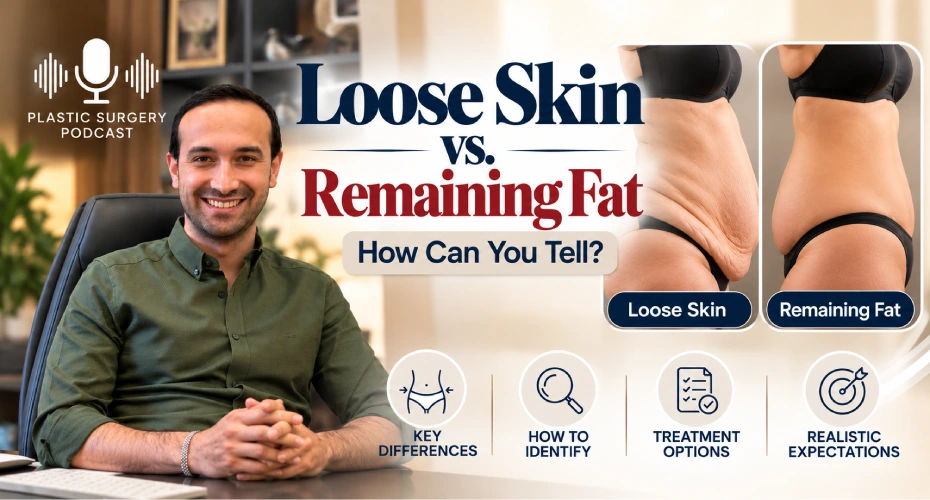
The main difference between loose skin and remaining fat is the type of tissue causing the fullness. Loose skin is redundant skin that has not fully retracted after weight loss, while remaining fat is adipose tissue still present beneath the skin or deeper inside the abdomen. Many people have a combination of both.
You’ve lost weight.
Your clothes fit differently. Your waist measurement may have decreased. You may feel stronger, healthier, and more comfortable in your body.
But when you look at your abdomen, something still bothers you.
There is a fold hanging over your lower stomach.
Perhaps your waist still appears wider than expected, or your arms and thighs still look larger than you imagined.
And one question keeps coming back:
Is this stubborn fat, or is it loose skin?
This question is particularly common after significant weight loss, including weight reduction following gastric sleeve surgery, gastric bypass, or lifestyle changes.
The answer matters because loose skin and remaining fat require different approaches.
Liposuction may help selected patients with localized fat deposits, but it does not remove substantial hanging skin.
A tummy tuck can remove excess abdominal skin, but it is not a treatment for visceral fat.
A circumferential body lift may address loose skin around the abdomen, waist, and lower back, but it is a more extensive operation with permanent scars and a significant recovery period.
Before considering any procedure, the first step is understanding what is actually creating the contour concern.
Loose Skin vs. Fat: Quick Comparison
| Feature | Loose Skin | Remaining Fat |
|---|---|---|
| What is it? | Redundant skin that has not fully retracted | Adipose tissue remaining after weight loss |
| Typical appearance | Hanging, folded, wrinkled, or deflated | Fuller, thicker, or rounded contour |
| Common after weight loss? | Yes | Yes |
| Can both occur together? | Yes | Yes |
| Does exercise remove it? | Cannot remove substantial redundant skin | May help reduce overall body fat |
| Can further weight loss help? | May not eliminate excess skin | May reduce fat, depending on the type and distribution |
| Does liposuction help? | Not directly | May help selected localized subcutaneous fat deposits |
| Does a tummy tuck help? | Can remove excess abdominal skin | May remove associated tissue but is not a weight-loss procedure |
| Does a body lift help? | Can address extensive lower-torso skin excess | May remove associated tissue but primarily targets excess skin |
| How is it assessed? | Clinical examination | Clinical examination; additional assessment when indicated |
Important: Appearance and touch alone cannot reliably determine the exact proportion of skin and fat. A hanging fold frequently contains both.
1. What Is Loose Skin After Weight Loss?
Loose skin after weight loss is excess skin that remains when the body’s volume decreases but the skin does not fully contract around its new shape.
Human skin contains structural proteins, including collagen and elastin.
These contribute to its strength, flexibility, and ability to stretch.
When body weight increases, the skin expands to accommodate the underlying tissue.
After substantial weight loss, the fat beneath the skin decreases.
However, the skin may not retract enough to match the smaller body volume.
This can leave folds of redundant tissue.
What Does Loose Skin Look Like?
Loose skin may appear:
- Wrinkled or creased
- Thin or deflated
- Hanging below the natural body contour
- Folded when standing or bending
- More noticeable when the body changes position
- Concentrated around the abdomen, arms, thighs, waist, or back
The appearance varies considerably.
Some patients have relatively thin folds.
Others have thicker folds containing a substantial layer of subcutaneous fat.
Therefore, loose skin does not always look thin.
Why Doesn’t Skin Tighten Completely After Weight Loss?
Several factors influence skin retraction.
Amount of Weight Lost
Major weight reduction can leave more redundant skin, although individual outcomes vary.
Duration of Previous Weight Gain
Skin that has been stretched for a prolonged period may have less capacity to retract fully.
Age
Skin characteristics and elasticity change with age.
Genetics
Individual differences in tissue structure influence how the skin responds to changes in body size.
Previous Fat Distribution
The areas where fat accumulated before weight loss often influence where excess skin remains afterward.
Skin Quality
Factors such as smoking, sun exposure, and previous tissue damage may affect skin quality.
Two people who lose the same amount of weight may have very different amounts of loose skin.
2. What Is Remaining Fat After Weight Loss?
Remaining fat is adipose tissue that remains in the body after weight reduction. It may be located directly beneath the skin or deeper inside the abdominal cavity.
Losing weight does not mean that every fat deposit disappears.
Body fat is distributed throughout the body, and different areas may change at different rates.
Some people continue to notice fullness around the abdomen, waist, hips, thighs, or upper arms.
However, the location of the fat is important.
There are two major types to understand.
Subcutaneous Fat
Subcutaneous fat is the fat located directly beneath the skin.
It contributes to the thickness and contour of areas such as the abdomen, waist, arms, and thighs.
This is the type of fat that liposuction can target in appropriately selected patients.
However, removing subcutaneous fat does not necessarily improve loose skin.
If skin elasticity is poor, fat removal may make laxity more noticeable.
Visceral Fat
Visceral fat is located deeper inside the abdominal cavity, around internal organs.
It can contribute to abdominal prominence.
Unlike subcutaneous fat, visceral fat cannot be removed through liposuction.
A tummy tuck also does not directly remove visceral fat.
This distinction is especially important for patients whose abdomen remains rounded despite substantial weight loss.
3. How Can You Tell Loose Skin From Belly Fat?
Loose skin may appear hanging, wrinkled, or folded, while subcutaneous fat often creates a thicker, fuller contour. However, these visual differences are not definitive, and a clinical examination is the best starting point.
Consider two patients who have both lost 100 pounds.
The first patient has a relatively smaller upper abdomen but a hanging fold extending over the lower abdomen.
The second patient has less hanging tissue but continues to have a rounded abdominal contour.
Although both patients have lost the same amount of weight, the anatomical reasons for their concerns may be different.
The first may have predominantly excess skin.
The second may have remaining fat, abdominal wall changes, or a combination.
Neither situation can be diagnosed from appearance alone.
Common Clues That May Suggest Loose Skin
- Hanging folds after substantial weight loss
- Wrinkling or creasing
- Tissue that appears deflated
- Excess skin extending below the natural abdominal contour
- Noticeable changes in the appearance of folds with body position
Common Clues That May Suggest Remaining Subcutaneous Fat
- Persistent localized fullness
- Thicker tissue beneath the skin
- A more rounded rather than deflated contour
- Fat deposits that remain despite changes elsewhere in the body
These clues may help patients describe their concerns, but they are not reliable diagnostic tests.
Many patients have both excess skin and residual fat in the same area.
4. Does the Pinch Test Work for Loose Skin vs. Fat?
The pinch test cannot reliably distinguish loose skin from remaining fat because a pinched fold usually contains skin and some amount of underlying subcutaneous tissue.
You may have seen advice suggesting that thin tissue indicates loose skin, while thick tissue indicates fat.
Although tissue thickness can provide a clue, the interpretation is not that simple.
A skin fold may contain:
- Epidermis and dermis
- Subcutaneous fat
- Connective tissue
- Other supporting structures
Pinching the abdomen cannot precisely measure these components.
It also cannot identify visceral fat, which is located deeper inside the abdomen.
Can You Diagnose Loose Skin at Home?
You may recognize signs of skin laxity, particularly after major weight loss.
However, determining whether the main problem is excess skin, residual fat, or abdominal wall structure generally requires a professional examination.
A plastic surgeon may assess tissue thickness, elasticity, fat distribution, and the location of skin folds.
Additional investigations may be considered if clinically indicated.
5. Why Is My Stomach Still Big After Losing Weight?
A stomach may remain prominent after weight loss because of loose abdominal skin, remaining subcutaneous fat, visceral fat, abdominal wall changes, or a combination of these factors.
Not every large-looking abdomen has the same cause.
This is why a patient who has lost significant weight may not benefit from simply continuing to lose more.
Cause 1: Hanging Abdominal Skin
After weight loss, excess skin may accumulate in the lower abdomen.
This can create a hanging fold known as an abdominal pannus.
The fold may contain skin and associated fatty tissue.
It can make the lower abdomen appear larger even when overall body fat has decreased.
Cause 2: Remaining Subcutaneous Fat
Some patients retain localized fat around the abdomen and flanks.
This may contribute to a thicker abdominal contour.
Cause 3: Visceral Fat
Fat inside the abdominal cavity may contribute to a rounded abdomen.
It cannot be removed with liposuction or abdominoplasty.
Cause 4: Abdominal Wall Changes
Changes in the abdominal wall, including muscle separation in some patients, may contribute to abdominal protrusion.
However, not every protruding abdomen is caused by muscle separation.
Cause 5: A Combination of Factors
Many patients have several contributing factors.
For example, a patient may have loose lower-abdominal skin, residual subcutaneous fat, and abdominal wall laxity.
A treatment that addresses only one component may not correct the entire contour concern.
6. What Is an Abdominal Pannus?
An abdominal pannus is a hanging fold of skin and associated tissue extending from the lower abdomen. It may remain after substantial weight loss.
A pannus can vary in size.
Some patients notice a small fold.
Others have more extensive tissue extending over the lower abdomen or pubic region.
An abdominal pannus may affect:
- Clothing fit
- Skin comfort
- Hygiene
- Physical movement
- Moisture accumulation
- Recurrent irritation in skin folds
The presence of a pannus does not automatically mean surgery is necessary.
However, persistent functional symptoms may justify evaluation for a skin-removal procedure.
7. Can You Have Loose Skin and Fat at the Same Time?
Yes. Loose skin and remaining fat frequently coexist after significant weight loss.
This is one of the most important reasons that treatment planning must be individualized.
A hanging abdominal fold is rarely made of skin alone.
It commonly includes subcutaneous tissue.
Likewise, an area with residual fat may also have reduced skin elasticity.
The relative contribution of each component influences the treatment plan.
For example:
- Predominantly loose abdominal skin may support consideration of abdominoplasty.
- Localized fat with adequate skin elasticity may support consideration of liposuction.
- Circumferential excess skin may support consideration of a lower body lift.
- Mixed concerns may require a combined or staged approach.
Not every patient requires surgery.
The appropriate decision depends on anatomy, health, expectations, and the balance of potential benefits and risks.
8. Can Exercise Get Rid of Loose Skin or Remaining Fat?
Exercise can improve body composition, muscle strength, and overall health, but it cannot remove substantial hanging skin.
The effects of exercise differ depending on the tissue involved.
Exercise and Body Fat
Physical activity can support fat reduction as part of a broader weight-management approach.
However, it is not possible to reliably choose exactly where the body loses fat through targeted exercises.
For example, abdominal exercises strengthen abdominal muscles but do not specifically remove fat from the stomach.
Exercise and Loose Skin
Resistance training may improve the appearance of underlying muscle contours.
However, increasing muscle mass does not eliminate large folds of redundant skin.
Patients with substantial skin excess may continue to have hanging tissue even after improving their fitness and body composition.
Exercise remains beneficial regardless of whether surgery is being considered.
9. Will Losing More Weight Remove Loose Skin?
Further weight loss may reduce remaining fat, but it does not necessarily eliminate redundant skin.
If localized fullness is mainly caused by fat, weight reduction may improve the contour.
However, if the primary concern is loose skin, additional weight loss may leave the folds unchanged or make them more noticeable.
This is especially relevant after major weight loss.
A patient may assume that the remaining abdominal fold means more fat needs to be lost.
But if the fold consists largely of excess skin, continued weight loss may not achieve the desired result.
Weight-loss decisions should be based on overall health and medical goals rather than appearance alone.
10. Can Loose Skin Tighten Naturally After Weight Loss?
Some skin retraction may occur after weight loss, but substantial redundant skin often persists.
The degree of natural tightening depends on factors including:
- Skin elasticity
- Age
- Genetics
- Previous body size
- Duration of tissue stretching
- Amount of weight lost
Mild laxity may improve in appearance.
However, large hanging folds are less likely to resolve completely without surgical removal.
There is no universal timeline or guaranteed degree of improvement.
11. Can Non-Surgical Skin-Tightening Treatments Help?
Non-surgical skin-tightening treatments may improve selected cases of mild laxity, but they generally cannot replace surgical removal of substantial hanging skin.
Energy-based treatments may produce modest tightening in appropriately selected patients.
The degree of improvement depends on the technology, treatment area, skin characteristics, and severity of laxity.
However, a patient with mild skin looseness is very different from someone with a large abdominal pannus.
Non-surgical treatments should not be presented as equivalent to a tummy tuck or body lift when extensive skin removal is required.
12. Can Liposuction Fix Loose Skin After Weight Loss?
No. Liposuction removes localized subcutaneous fat but does not remove significant redundant skin.
Liposuction can be useful when the main concern is localized fat and the skin has sufficient elasticity to adapt to the reduced volume.
However, when significant skin laxity is already present, removing additional fat may leave the area looking more deflated.
This is why liposuction is not automatically the right procedure for a hanging abdomen.
Can Liposuction Make Loose Skin More Noticeable?
Yes, in some patients.
If fat is removed from an area with poor skin elasticity, the remaining skin may not retract adequately.
The degree of change depends on the amount of fat removed, tissue characteristics, and technique.
Appropriate patient selection is essential.
13. Tummy Tuck vs. Liposuction: Which Is Better for Your Abdomen?
Liposuction primarily removes localized fat, while a tummy tuck removes excess abdominal skin and may include abdominal wall tightening.
| Feature | Liposuction | Tummy Tuck |
|---|---|---|
| Main purpose | Localized fat removal | Abdominal skin removal and contour improvement |
| Removes substantial loose skin? | No | Yes |
| Removes subcutaneous fat? | Yes | Some associated fat may be removed |
| Treats visceral fat? | No | No |
| Can tighten abdominal wall? | No | When indicated |
| Scar pattern | Small access incisions | Longer lower-abdominal incision, often with an umbilical scar |
| Appropriate for major hanging skin? | Generally not as a standalone procedure | May be appropriate |
| Recovery | Depends on extent | Generally more extensive |
The decision depends on which tissue is creating the concern.
A patient with good skin elasticity and localized fat may benefit from liposuction.
A patient with substantial abdominal skin excess may require a tummy tuck for meaningful skin removal.
14. When Is a Tummy Tuck More Appropriate Than Liposuction?
A tummy tuck may be more appropriate when significant excess abdominal skin is the main concern, particularly when abdominal wall tightening is also indicated.
After major weight loss, the abdomen may have:
- Hanging lower-abdominal skin
- Skin folds
- Reduced elasticity
- Abdominal wall laxity
- Residual subcutaneous fat
A tummy tuck can address selected skin and abdominal wall concerns.
However, it is not a weight-loss operation and cannot remove visceral fat.
The procedure leaves permanent scars and carries surgical risks.
15. When Is a 360 Body Lift More Appropriate Than a Tummy Tuck?
A 360 body lift may be considered when excess skin extends around the abdomen, waist, flanks, and lower back rather than remaining concentrated on the front of the abdomen.
A tummy tuck primarily addresses the abdomen.
A circumferential lower body lift treats a larger area of the lower torso.
Depending on the technique, it may also improve sagging around the buttocks and outer thighs.
Tummy Tuck vs. 360 Body Lift
| Feature | Tummy Tuck | 360 Body Lift |
|---|---|---|
| Abdominal skin removal | Yes | Usually |
| Waist and flank skin | Limited or extended correction | Commonly addressed |
| Lower-back folds | Not directly | Commonly addressed |
| Buttock sagging | Not directly | May improve |
| Outer-thigh laxity | Limited | May improve |
| Incision | Primarily lower abdomen | Around much or all of the lower torso |
| Recovery | Significant | Often more demanding |
A larger operation is not automatically better.
The surgical plan should match the distribution of excess skin and the patient’s medical suitability.
16. Can a Tummy Tuck and Liposuction Be Combined?
Liposuction and tummy tuck surgery may be combined in selected patients, but the decision depends on anatomy, tissue blood supply, medical history, and surgical risk.
Some patients have both abdominal skin excess and localized fat deposits.
In these cases, a combined approach may be considered.
However, adding liposuction can increase the extent of surgery.
The surgeon must consider the safety of the tissues, operative duration, and potential wound-healing complications.
Not every patient is a suitable candidate for combined procedures.
17. How Does a Plastic Surgeon Determine Whether It’s Skin or Fat?
A plastic surgeon evaluates the location, thickness, and elasticity of the tissues, the distribution of fat, abdominal wall structure, and the patient’s overall health.
A clinical assessment may include several components.
Skin Examination
The surgeon evaluates:
- Skin laxity
- Hanging folds
- Elasticity
- Stretch marks
- Previous scars
- Tissue quality
Subcutaneous Fat Assessment
The examination considers the thickness and distribution of fatty tissue beneath the skin.
Abdominal Wall Assessment
The surgeon may evaluate abdominal wall contour and possible muscle separation.
Medical History
Important factors include:
- Weight-loss history
- Weight stability
- Previous bariatric surgery
- Previous abdominal operations
- Medical conditions
- Smoking and nicotine exposure
- Nutritional status
Additional Assessment
When clinically indicated, additional tests or imaging may be considered.
However, not every patient requires imaging to evaluate skin excess or localized fat.
18. Does BMI Tell You Whether You Have Loose Skin or Fat?
No. BMI cannot distinguish loose skin from subcutaneous fat, visceral fat, or muscle mass.
Body mass index is calculated using height and weight.
It is useful as one general measure in medical assessment.
However, it does not reveal the composition or distribution of body tissues.
Two patients with the same BMI may have very different body contours.
One may have substantial redundant skin after major weight loss.
Another may have more subcutaneous fat and relatively good skin elasticity.
Therefore, BMI alone cannot determine which body-contouring procedure is appropriate.
19. Why Does Loose Skin Look Different When Standing or Sitting?
Loose skin can change appearance with body position because redundant tissue folds, hangs, or bunches as the body moves.
For example, excess abdominal skin may hang downward when standing.
When sitting, the same tissue may form additional folds.
However, subcutaneous fat can also change shape with body position.
Therefore, positional changes are not a definitive way to distinguish skin from fat.
A physical examination remains important.
20. Is Loose Skin More Noticeable After Losing 100 Pounds?
Loose skin may become particularly noticeable after losing 100 pounds because the reduction in underlying fat volume can leave substantial redundant tissue.
However, the amount of skin excess varies.
Some people experience relatively good skin retraction.
Others develop hanging folds around the abdomen, arms, thighs, and back.
The amount of weight lost does not precisely predict the final appearance.
21. Why Do My Arms Still Look Fat After Weight Loss?
Upper arms may remain large-looking after weight loss because of loose skin, remaining fat, or both.
The underside of the upper arm is a common location for skin laxity.
Resistance training can strengthen the muscles.
However, it cannot remove significant redundant skin.
An arm lift, also called brachioplasty, may be considered when substantial skin excess remains.
The procedure leaves a permanent scar and requires individualized surgical assessment.
22. Why Do My Thighs Still Look Big After Weight Loss?
Thigh fullness after weight loss may be caused by remaining fat, loose skin, or a combination of the two.
The treatment depends on the area involved.
Localized fat deposits may be evaluated for liposuction.
Significant inner-thigh skin excess may require a thigh lift.
Selected outer-thigh laxity may improve with a lower body lift.
The appropriate operation depends on anatomy and surgical suitability.
23. Why Do I Still Have Back Rolls After Losing Weight?
Back rolls may remain after weight loss because of residual fat deposits, loose skin, or both.
Lower-back skin folds may be addressed by a circumferential lower body lift in selected patients.
Localized fat deposits may be treated differently.
Skin folds located higher on the back may require separate evaluation.
The location of the tissue is important when planning treatment.
24. When Should You Consider Skin Removal Surgery?
Skin-removal surgery is generally considered when substantial excess skin remains, weight is reasonably stable, and the patient is medically suitable for an elective operation.
Important considerations include:
- Weight stability
- Nutritional status
- Overall health
- Previous bariatric surgery
- Smoking and nicotine exposure
- Distribution of skin excess
- Expectations about scars
- Recovery requirements
- Individual surgical risks
Patients who are still losing substantial weight may be advised to postpone surgery.
Further weight changes can affect the contour after skin removal.
25. What Are the Risks of Skin Removal Surgery?
Skin-removal procedures carry risks including wound-healing problems, infection, bleeding, fluid collections, blood clots, and permanent scarring.
Potential complications include:
- Wound separation
- Delayed healing
- Seroma
- Hematoma
- Infection
- Tissue necrosis
- Contour irregularities
- Changes in sensation
- Unfavorable scars
- Deep vein thrombosis
- Pulmonary embolism
- Anesthesia-related complications
The level of risk depends on the procedure, patient health, nutritional status, and surgical extent.
Careful patient selection is essential.
26. Are Skin Removal Surgery Scars Permanent?
Yes. Procedures that remove substantial excess skin leave permanent scars.
The location depends on the operation.
A tummy tuck generally leaves a lower-abdominal scar.
A circumferential body lift leaves a scar extending around the lower torso.
An arm lift may leave a scar along the upper arm.
Scars often become softer and less noticeable over time.
However, they do not disappear completely.
Patients should understand the expected scar pattern before surgery.
27. Will Removing Loose Skin Make You Look Thinner?
Removing excess skin may improve body contour and reduce the appearance of hanging tissue, but it cannot guarantee a specific body shape or waist measurement.
The final result depends on:
- Remaining subcutaneous fat
- Visceral fat
- Abdominal wall structure
- Skeletal anatomy
- Skin quality
- Surgical technique
- Healing
The objective is realistic contour improvement rather than a guaranteed appearance.
28. Can Loose Skin Return After Surgery?
Removed skin does not grow back, but the remaining tissues can stretch or sag with aging and weight changes.
Significant weight gain may stretch the skin.
Further weight loss may create new laxity.
Maintaining a reasonably stable weight may help preserve the surgical contour.
However, no procedure can stop natural aging.
Loose Skin vs. Fat: Which Treatment May Be Appropriate?
| Main Concern | Potential Approach | Important Limitation |
|---|---|---|
| Mild skin laxity | Observation or selected non-surgical treatments | Results may be modest |
| Localized subcutaneous fat | Weight management or selected liposuction | Liposuction does not remove substantial skin |
| Significant abdominal skin excess | Tummy tuck | Permanent scars and surgical risks |
| Hanging abdominal pannus | Panniculectomy or other appropriate abdominal surgery | Procedure depends on functional and anatomical concerns |
| Circumferential lower-torso skin excess | Lower body lift | Extensive operation and recovery |
| Loose upper-arm skin | Arm lift | Permanent arm scar |
| Significant thigh skin excess | Thigh lift | Permanent scars |
| Visceral abdominal fat | Medical weight-management approach | Not removed by liposuction or tummy tuck |
| Mixed skin and fat concerns | Individualized or staged treatment | Requires careful surgical planning |
There is no single treatment that is appropriate for every patient with post-weight-loss contour concerns.
Loose Skin vs. Remaining Fat: Evaluation in Istanbul, Turkey
Patients considering loose skin removal or body contouring after weight loss in Istanbul, Turkey, should begin with an individualized anatomical and medical assessment.
Dr. Burak Pasinlioğlu, a European Board Certified Plastic Surgeon (EBOPRAS) based in Istanbul, Turkey, evaluates post-weight-loss contour concerns according to the distribution of excess skin, remaining fat, abdominal wall structure, medical history, and patient goals.
An evaluation may help determine whether the main concern is:
- Redundant abdominal skin
- Localized subcutaneous fat
- Circumferential lower-torso skin excess
- Abdominal wall changes
- A combination of several factors
Depending on the findings, possible options may include tummy tuck, liposuction, lower body lift, or another individualized approach.
Not every patient requires surgery.
For international patients, postoperative planning is especially important when considering extensive body-contouring procedures.
Recovery arrangements, wound care, follow-up appointments, and return travel should be discussed before surgery.
The objective is to identify the anatomical cause of the concern and choose a medically appropriate plan—not simply to remove as much tissue as possible.
Frequently Asked Questions: Loose Skin vs. Remaining Fat
This FAQ section is structured to provide clear, direct answers to common questions about loose skin, stubborn fat, abdominal contour, and post-weight-loss body-contouring procedures.
1. How do I know if I have loose skin or fat?
Loose skin often appears wrinkled, hanging, or folded, while subcutaneous fat typically creates a fuller contour. However, many skin folds contain both skin and fat. A clinical examination is the best starting point for determining which tissue is responsible.
2. What is the difference between loose skin and belly fat?
Loose skin is redundant skin that has not fully retracted, while belly fat is adipose tissue located beneath the skin or inside the abdominal cavity. Both can contribute to abdominal fullness.
3. Can loose skin feel like fat?
Yes. Loose skin often contains underlying fatty tissue, so it may feel soft or thick when touched. Texture alone cannot reliably distinguish the two.
4. Does the pinch test tell you if it’s skin or fat?
No. The pinch test may provide clues about tissue thickness, but it cannot accurately separate skin from subcutaneous fat or identify visceral fat.
5. Is thin, wrinkled tissue always loose skin?
Not necessarily. Thin, wrinkled tissue may suggest skin laxity, but the area can still contain underlying fat. Appearance alone is not diagnostic.
6. Is thick, soft tissue always fat?
No. A thick fold may contain both redundant skin and subcutaneous fat. Clinical assessment is needed to understand the tissue composition.
7. Why does my stomach hang even though I’ve lost weight?
Your stomach may hang because stretched abdominal skin has not fully retracted after weight loss. Remaining subcutaneous fat may also contribute to the fold.
8. Why is my lower belly still big after weight loss?
A prominent lower belly may result from hanging skin, residual fat, abdominal wall changes, or a combination of these factors. The appropriate treatment depends on the underlying cause.
9. Can loose skin make you look overweight?
Yes. Hanging folds can create the appearance of additional volume even after substantial weight reduction.
10. Can you have loose skin at a healthy BMI?
Yes. BMI does not measure skin elasticity or redundant tissue. A person may have significant loose skin despite being within a medically appropriate weight range.
11. Does losing 100 pounds always cause loose skin?
No. The amount of loose skin varies according to age, genetics, previous body size, skin elasticity, and other factors.
12. Can loose skin disappear without surgery?
Mild skin laxity may improve, but substantial hanging skin often persists. Surgery is generally the most direct method of removing large amounts of redundant tissue.
13. How long does loose skin take to tighten after weight loss?
There is no universal timeline. Skin may continue adapting after weight stabilizes, but significant folds may remain permanently without surgical removal.
14. Can exercise turn loose skin into muscle?
No. Exercise can strengthen muscles beneath the skin, but it cannot transform skin into muscle or remove redundant tissue.
15. Can weight training tighten loose skin?
Weight training may improve muscle definition and overall contour, but it cannot remove substantial hanging skin.
16. Can abdominal exercises remove loose belly skin?
No. Abdominal exercises strengthen muscles but do not eliminate redundant abdominal skin.
17. Will losing more weight help loose skin?
Further weight loss may reduce remaining fat but may not improve excess skin. In some cases, the folds become more noticeable as fat volume decreases.
18. Can loose skin contain fat?
Yes. Hanging skin folds frequently contain subcutaneous fat and connective tissue.
19. Can I have loose skin and stubborn fat together?
Yes. Many patients have both, particularly after significant weight loss. Treatment planning should account for the relative contribution of each.
20. What is subcutaneous fat?
Subcutaneous fat is adipose tissue located directly beneath the skin. It contributes to body contour and may be targeted by liposuction in selected patients.
21. What is visceral fat?
Visceral fat is fat located inside the abdominal cavity around internal organs. It can contribute to abdominal prominence and cannot be removed through liposuction.
22. Can liposuction remove visceral fat?
No. Liposuction removes selected subcutaneous fat deposits, not visceral fat.
23. Can a tummy tuck remove visceral fat?
No. A tummy tuck primarily addresses excess abdominal skin and may include abdominal wall tightening. It does not directly remove visceral fat.
24. Can liposuction remove loose skin?
No. Liposuction removes fat but does not surgically excise redundant skin.
25. Can liposuction make loose skin worse?
It may make existing laxity more noticeable in some patients. This can occur when fat is removed but the remaining skin does not retract sufficiently.
26. Is liposuction better than a tummy tuck for belly fat?
Liposuction may be more appropriate for localized subcutaneous fat when skin elasticity is sufficient. A tummy tuck is generally more appropriate when significant excess abdominal skin is present.
27. How do I know if I need liposuction or a tummy tuck?
The decision depends on whether the main concern is localized fat, excess skin, abdominal wall changes, or a combination. A plastic surgery examination can help identify the appropriate approach.
28. Can you combine tummy tuck and liposuction?
Yes, in selected patients. Combining procedures requires evaluation of tissue blood supply, surgical extent, and individual complication risks.
29. What is the difference between a tummy tuck and a 360 body lift?
A tummy tuck primarily addresses the abdomen, while a circumferential lower body lift treats excess skin around the abdomen, flanks, and lower back.
30. Is a 360 body lift better than a tummy tuck after weight loss?
Not necessarily. A body lift may be more appropriate when skin excess extends around the lower torso. A tummy tuck may be sufficient when the concern is primarily abdominal.
31. What is the best surgery for loose skin after losing 100 pounds?
There is no single best procedure. Options may include tummy tuck, lower body lift, arm lift, or thigh lift, depending on the location and severity of excess skin.
32. What is an abdominal pannus?
An abdominal pannus is a hanging fold of skin and associated tissue extending from the lower abdomen. It may develop after major weight loss.
33. Is an abdominal pannus loose skin or fat?
It commonly contains both. An abdominal pannus consists of redundant skin and associated underlying tissue, which may include subcutaneous fat.
34. Can a pannus disappear with weight loss?
Further weight loss may reduce fat within the fold, but significant redundant skin may remain.
35. What is the difference between panniculectomy and tummy tuck?
A panniculectomy primarily removes hanging lower-abdominal tissue, while a tummy tuck focuses on abdominal contouring and may include muscle tightening.
36. Can abdominal muscle separation make you look fat?
Abdominal wall separation may contribute to a protruding abdominal contour in some patients. However, not every prominent abdomen is caused by muscle separation.
37. Can a tummy tuck repair separated abdominal muscles?
Yes, when indicated. Abdominal wall tightening may be performed during abdominoplasty, depending on the patient’s anatomy.
38. Can non-surgical skin tightening replace a tummy tuck?
Generally not when substantial hanging skin is present. Non-surgical treatments may provide modest improvements in selected cases of mild laxity.
39. Does radiofrequency tighten loose skin after weight loss?
Radiofrequency-based treatments may improve selected cases of mild laxity, but they cannot reliably remove substantial redundant skin. Results vary by device, treatment area, and patient characteristics.
40. Can skin-tightening creams remove loose skin?
Topical products cannot remove significant hanging skin. They may improve skin hydration or surface appearance but do not replace surgical skin removal.
41. Why do my arms still look fat after weight loss?
The appearance may result from upper-arm skin laxity, residual fat, or both. Significant excess skin may be evaluated for an arm lift.
42. Why do my thighs still look large after weight loss?
Remaining fat and loose skin can both affect thigh contour. Treatment depends on whether the concern is predominantly fat, skin, or a combination.
43. Why do I still have back rolls after weight loss?
Back rolls may consist of remaining fat, redundant skin, or both. The location and tissue characteristics determine which treatment options may be appropriate.
44. Does BMI tell you how much body fat you have?
No. BMI uses height and weight but does not directly measure body fat percentage, skin excess, or fat distribution.
45. Do I need to reach a certain BMI before skin removal surgery?
There is no universal BMI cutoff for all patients. Surgeons evaluate BMI alongside medical conditions, weight stability, nutritional status, and individual risks.
46. When should I consider skin removal surgery after weight loss?
Surgery may be considered when substantial excess skin remains, weight is reasonably stable, and the patient is medically suitable.
47. Can I have skin removal surgery after gastric sleeve?
Yes, in selected patients. Weight stability, nutritional status, and medical readiness are particularly important after bariatric surgery.
48. Are scars permanent after loose skin removal?
Yes. Skin-removal procedures leave permanent scars, although their appearance may improve as they mature.
49. Can loose skin return after a tummy tuck or body lift?
Removed skin does not grow back, but remaining tissues can stretch or sag with aging and weight fluctuations.
50. How can a plastic surgeon tell whether I need fat removal or skin removal?
A plastic surgeon assesses skin elasticity, tissue thickness, fat distribution, abdominal wall structure, weight history, and overall health. These findings help determine whether liposuction, skin removal, another approach, or no surgery is appropriate.
Medical References
The following professional medical resources and scientific publications provide further information about skin structure, body fat distribution, liposuction, abdominoplasty, body-contouring surgery, and post-weight-loss surgical considerations.
1. American Society of Plastic Surgeons (ASPS) — Liposuction Overview. Information about localized subcutaneous fat removal, procedure goals, and treatment limitations.
https://www.plasticsurgery.org/cosmetic-procedures/liposuction
2. American Society of Plastic Surgeons (ASPS) — Tummy Tuck Overview. Information about abdominoplasty, abdominal skin removal, and contour improvement.
https://www.plasticsurgery.org/cosmetic-procedures/tummy-tuck
3. American Society of Plastic Surgeons (ASPS) — Body Lift Overview. Information about circumferential body-contouring surgery and excess skin removal.
https://www.plasticsurgery.org/cosmetic-procedures/body-lift
4. American Society of Plastic Surgeons (ASPS) — Body Lift Candidates. General considerations for surgical suitability after significant weight loss.
https://www.plasticsurgery.org/cosmetic-procedures/body-lift/candidates
5. American Society of Plastic Surgeons (ASPS) — Body Lift Risks and Safety. Information about recognized complications associated with body lift surgery.
https://www.plasticsurgery.org/cosmetic-procedures/body-lift/safety
6. American Society of Plastic Surgeons (ASPS) — Arm Lift Overview. Information about upper-arm skin removal through brachioplasty.
https://www.plasticsurgery.org/cosmetic-procedures/arm-lift
7. American Society of Plastic Surgeons (ASPS) — Thigh Lift Overview. Information about surgical treatment of excess thigh skin.
https://www.plasticsurgery.org/cosmetic-procedures/thigh-lift
8. National Institute of Diabetes and Digestive and Kidney Diseases (NIDDK) — Health Risks of Overweight and Obesity. General information about excess body fat and associated health considerations.
https://www.niddk.nih.gov/health-information/weight-management/adult-overweight-obesity/health-risks
9. Centers for Disease Control and Prevention (CDC) — About Body Mass Index (BMI). Information about BMI as a screening measure and its limitations.
https://www.cdc.gov/bmi/about/index.html
10. American Academy of Dermatology (AAD) — Public Education Resources. General educational information about skin structure, aging, and skin health.
11. Hasanbegovic E, Sørensen JA. Complications Following Body Contouring Surgery After Massive Weight Loss: A Meta-Analysis. Journal of Plastic, Reconstructive & Aesthetic Surgery. 2014. A meta-analysis examining complications following post-weight-loss body-contouring surgery.
12. AACE/TOS/ASMBS/OMA/ASA Clinical Practice Guidelines — Perioperative Nutrition, Metabolic, and Nonsurgical Support of Patients Undergoing Bariatric Procedures. 2019 Update. Guidance concerning nutritional assessment and medical management following bariatric surgery.
https://pubmed.ncbi.nlm.nih.gov/31682518
Reference note: The listed resources are provided for further reading. Individual scientific findings and the current availability of every linked page have not been independently reverified for this article.
Medical Disclaimer: This article is intended for general educational purposes and does not replace individualized medical advice, diagnosis, or surgical consultation. The distinction between loose skin and remaining fat may require clinical examination. Treatment suitability depends on anatomy, medical history, nutritional status, weight stability, and individual risks. Surgical procedures carry potential complications, and results vary between patients.