


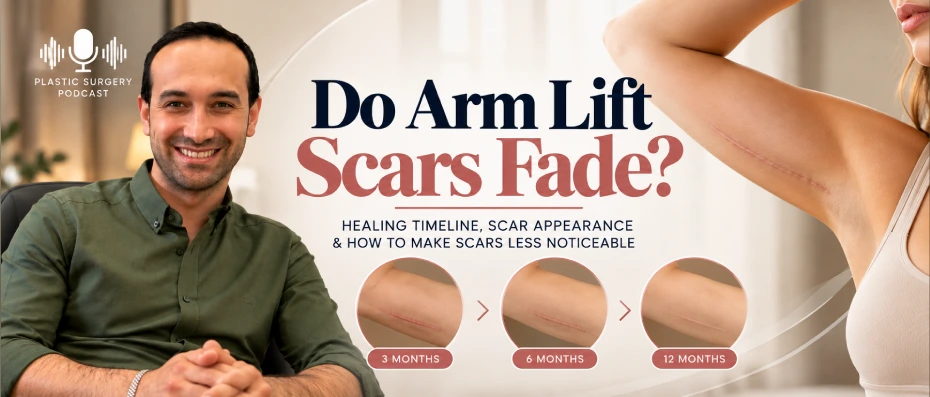
Yes. Arm lift scars usually become less noticeable as they mature, but they are permanent and do not disappear completely.
An arm lift, medically known as brachioplasty, removes excess skin from the upper arms. It is commonly considered by patients who have developed significant loose, hanging skin after weight loss or as a result of aging and reduced skin elasticity.
However, removing excess skin requires an incision.
And every surgical incision creates a scar.
During the first months after an arm lift, the scar may appear red, pink, darker than the surrounding skin, slightly raised or firm.
As healing progresses, many scars gradually become:
- Flatter
- Softer
- Less red
- Less prominent
- More similar in color to the surrounding skin
For many patients, scar maturation continues for 12–18 months or longer.
However, scar appearance varies considerably. Some scars remain noticeable because of pigmentation changes, widening, thickening or individual healing characteristics.
The goal of brachioplasty is therefore not scar-free surgery.
It is to improve upper-arm contour while creating a scar that is as well-positioned and manageable as possible.
Quick Answer: How Long Do Arm Lift Scars Take to Fade?
Arm lift scars often change significantly during the first year, but complete scar maturation may take 12–18 months or longer.
| Time After Surgery | What You May Notice |
|---|---|
| First 2–3 weeks | Incisions are healing; redness, swelling and tenderness may be present |
| 1 month | Scar may look pink, red, darker or firm |
| 3 months | Scar may remain prominent or temporarily become more noticeable |
| 6 months | Some scars begin to flatten, soften and fade |
| 12 months | Many scars look more mature and less noticeable |
| 18–24 months | Additional changes in scar color, thickness and texture may occur |
These are general stages of scar maturation, not guaranteed outcomes or precise healing deadlines.
A scar that looks prominent at three months may look very different after one year.
But a scar that remains thick, raised or symptomatic may need additional assessment rather than simply waiting indefinitely.
What Do Arm Lift Scars Look Like?
Arm lift scars usually appear as linear scars along the inner or back portion of the upper arm, although their length and location depend on how much excess skin must be removed.
For patients with significant hanging skin, the incision may extend from the armpit toward the elbow.
For patients with limited skin excess concentrated near the armpit, a shorter incision may sometimes be possible.
The final appearance depends on:
- Incision placement
- Skin quality
- Amount of skin removed
- Tension on the wound
- Individual scar formation
- Healing complications
- Scar care
- Time since surgery
Some mature scars become thin and relatively subtle.
Others remain wider, darker or more visible.
Even a well-healed scar may be noticeable when the arm is raised.
Are Arm Lift Scars Permanent?
Yes. Brachioplasty scars are permanent because surgery creates a lasting change in the skin.
Scar tissue is the body’s natural way of repairing a wound.
It differs structurally from uninjured skin.
As a scar matures, its appearance can improve, but the scar does not transform back into completely normal, uninjured skin.
This distinction is important because patients sometimes confuse:
Scar fading with scar disappearance.
They are not the same thing.
A faded scar may become less obvious in everyday situations.
But it can still be visible under certain lighting, when the arm is raised or when viewed closely.
Do Arm Lift Scars Ever Disappear Completely?
No. Arm lift scars do not normally disappear completely, although some become relatively inconspicuous over time.
There is currently no treatment that can guarantee the complete removal of a surgical scar.
Silicone treatments, laser procedures and selected scar-revision techniques may improve certain scar characteristics.
But they do not restore the skin to its exact pre-incision condition.
Patients should therefore be cautious of claims such as:
- Scar-free arm lift
- Invisible brachioplasty scar
- Guaranteed scar removal
- No-scar skin removal
Significant excess skin cannot be surgically removed without creating an incision.
Why Do Arm Lift Scars Look Worse Before They Look Better?
Surgical scars can temporarily become redder, firmer or more raised during early scar maturation before gradually softening and fading.
This can surprise patients.
During the early healing process, the body produces collagen and remodels the injured tissue.
Scar tissue may initially be more vascular and active.
This can make it appear:
- Pink or red
- Firm
- Slightly elevated
- Sensitive
- More noticeable than expected
Over time, remodeling may reduce redness and improve texture.
However, not every raised scar represents normal maturation.
A scar that becomes progressively thick, itchy, painful or unusually prominent may be developing hypertrophic scarring or another scar-related problem.
Arm Lift Scar Healing Timeline: What to Expect Month by Month
What Do Arm Lift Scars Look Like After 2 Weeks?
At two weeks, arm lift incisions are generally still in an early healing phase, and their appearance does not predict the final scar.
Depending on healing, patients may notice:
- Redness near the incision
- Swelling
- Tenderness
- Scabbing or residual wound closure
- Tightness when moving the arms
Not every incision is fully healed at exactly two weeks.
Patients should follow their surgeon’s instructions regarding dressings, arm movement and wound care.
Silicone scar products should generally not be started on open or incompletely healed areas without specific medical guidance.
What Do Arm Lift Scars Look Like After 1 Month?
At one month, arm lift scars may still be pink, red, darker than the surrounding skin or relatively firm.
The skin surface may have closed, but deeper tissue remodeling continues.
Patients may also notice tightness along the incision.
This does not automatically mean the scar will remain prominent permanently.
However, increasing redness, warmth, drainage, wound separation or worsening pain should be evaluated.
Do Arm Lift Scars Fade After 3 Months?
Some improvement may be visible by three months, but arm lift scars are usually still immature at this stage.
For certain patients, the scar may temporarily appear more prominent.
This can be part of normal remodeling.
The final scar should not be judged solely from a three-month photograph.
What Do Arm Lift Scars Look Like After 6 Months?
By six months, some brachioplasty scars have become flatter and less red, but others remain relatively noticeable.
Scar maturation varies.
A patient with uncomplicated healing and a thin scar may see considerable improvement.
Another patient may still have:
- Redness
- Hyperpigmentation
- Firmness
- Scar widening
- Raised areas
Persistent changes should be assessed according to their appearance and symptoms.
Do Arm Lift Scars Look Better After 1 Year?
Many arm lift scars look less noticeable after one year because collagen remodeling and scar maturation have progressed.
Compared with the early postoperative period, a mature scar may be:
- Softer
- Flatter
- Less red
- Less sensitive
- Less visually prominent
However, one year is not a guarantee that every scar has reached its final appearance.
Some scars continue improving beyond this point.
Do Arm Lift Scars Continue Fading After 18 Months?
Yes. Some surgical scars continue to change after 18 months, although the amount of additional improvement becomes increasingly individual.
A scar may gradually become paler or softer.
But a significantly widened, thickened or keloid scar should not be expected to disappear simply because more time passes.
Where Is the Arm Lift Scar Located?
The scar is commonly placed along the inner or posterior-inner upper arm, with its length determined by the distribution and amount of excess skin.
During brachioplasty planning, the surgeon considers both contour improvement and scar location.
For substantial upper-arm skin excess, the incision often extends along much of the upper arm.
If loose tissue extends toward the lateral chest, a more extensive incision may sometimes be required.
The aim is to position the scar thoughtfully while allowing enough skin removal to improve the contour.
However, no location guarantees that the scar will remain invisible in every arm position.
Is the Arm Lift Scar Visible When Your Arms Are Down?
An arm lift scar may be less noticeable when the arms rest naturally at the sides, depending on incision placement, but it can still be visible.
Visibility depends on:
- Scar location
- Arm position
- Scar color
- Scar width
- Skin pigmentation
- Clothing
- Lighting
A scar placed along the inner arm may be relatively concealed in some positions.
When the arms are raised, however, it may become more visible.
Patients should evaluate scars in multiple arm positions when considering surgery.
Is an Inner-Arm Scar Better Than a Back-of-Arm Scar?
Neither scar location is universally better; the appropriate position depends on anatomy, skin excess, surgical technique and the patient’s priorities.
Inner-arm placement may make the scar less visible from certain angles.
Posteromedial placement may be preferred in other situations.
Both approaches have advantages and limitations.
The scar should not be positioned solely according to which line appears shortest in a photograph.
Adequate tissue removal, wound tension and contour must also be considered.
Can You Have an Arm Lift With a Short Scar?
A short-scar arm lift may be possible when excess skin is limited and concentrated near the armpit, but it is generally not suitable for substantial skin hanging along the full upper arm.
A limited incision cannot remove the same amount of skin as a longer incision.
This is a basic surgical trade-off.
If significant skin excess extends toward the elbow, attempting to correct it through a very small incision may leave substantial laxity behind.
The appropriate incision length is determined by the amount and location of excess tissue.
Can You Get an Arm Lift Without a Scar?
No. A surgical arm lift that removes excess skin requires an incision and therefore leaves a scar.
The term scarless arm lift is sometimes used in marketing for treatments that do not actually remove significant excess skin.
These may involve technologies intended to improve skin tightening.
However, they are not equivalent to traditional brachioplasty.
Patients with significant hanging skin should understand the difference between:
Skin tightening and skin removal.
Why Are Some Arm Lift Scars More Noticeable Than Others?
Arm lift scar appearance depends on a combination of genetics, skin characteristics, wound tension, healing complications and individual scar biology.
Two patients can undergo similar procedures and develop very different scars.
Important factors include:
Genetics
Some people naturally form thicker or more prominent scars.
Skin pigmentation
Scar discoloration may be more noticeable in certain skin types, including persistent post-inflammatory hyperpigmentation.
Wound tension
Higher tension across a healing incision can contribute to scar widening or unfavorable healing.
Wound complications
Infection, wound separation or delayed healing can affect scar quality.
Nicotine exposure
Nicotine and smoking-related effects can interfere with normal wound healing and increase complication risks.
Sun exposure
Ultraviolet exposure can worsen discoloration in healing scars.
Individual collagen response
Some patients develop hypertrophic scars or keloids.
Because these factors differ, the final scar cannot be predicted with complete accuracy.
Can Arm Lift Scars Become Raised?
Yes. Some brachioplasty scars become raised because of increased scar tissue formation during healing.
A raised scar may be:
- Firm
- Thick
- Red
- Itchy
- Sensitive
- More visible than the surrounding skin
Raised scars are not all the same.
Two important categories are hypertrophic scars and keloids.
What Is a Hypertrophic Arm Lift Scar?
A hypertrophic scar is a raised scar that remains within the boundaries of the original surgical incision.
It may appear:
- Thickened
- Red or pink
- Firm
- Itchy
- Elevated
Some hypertrophic scars improve with time.
Others benefit from treatments such as silicone therapy, corticosteroid injections or selected laser procedures.
The treatment depends on scar maturity, symptoms and appearance.
What Is a Keloid After an Arm Lift?
A keloid is an abnormal scar that grows beyond the boundaries of the original wound.
Keloids are different from ordinary raised scars.
They may:
- Extend beyond the incision
- Continue growing
- Cause itching
- Cause discomfort
- Recur after treatment
Patients with a personal or family history of keloids should discuss this before elective surgery.
Scar management may require a combination of approaches, and recurrence remains possible.
Why Are My Arm Lift Scars Dark?
Dark arm lift scars may result from post-inflammatory hyperpigmentation, which can occur as the skin responds to injury and inflammation.
This is particularly relevant in patients prone to pigmentation changes.
Dark scars are not necessarily raised.
They may be flat but noticeably darker than surrounding skin.
Management differs from treatment of thick, raised scars.
Sun protection is important because ultraviolet exposure may worsen pigmentation.
Some pigment-related treatments can help selected patients, but treatment should be chosen carefully to avoid further irritation or discoloration.
Why Are My Arm Lift Scars Red After Several Months?
Persistent redness can reflect ongoing scar maturation, but pronounced or worsening redness may require evaluation.
New scars often contain more visible blood vessels.
As they mature, redness may gradually decrease.
However, redness associated with warmth, increasing pain, drainage or swelling should not automatically be considered normal scar maturation.
Why Are My Arm Lift Scars Wide?
Scar widening can occur when healing tissue stretches or when tension and other factors affect the developing scar.
The upper arms move frequently during everyday activities.
This makes appropriate postoperative movement restrictions and wound care important.
Scar widening can also occur despite careful surgery and good compliance.
A wide mature scar may sometimes be considered for revision, but scar revision creates a new scar and cannot guarantee a narrower result.
What Helps Arm Lift Scars Fade?
Appropriate wound healing, sun protection and selected evidence-based scar treatments may help improve the appearance of arm lift scars, although no method can guarantee an invisible scar.
Common scar-management approaches include:
- Following postoperative wound-care instructions
- Avoiding nicotine exposure
- Protecting healing scars from sunlight
- Silicone gel or silicone sheets after wound closure
- Monitoring for raised or thickened scars
- Selected laser treatments
- Corticosteroid treatment for appropriate abnormal scars
- Scar revision in selected mature scars
The best approach depends on the type of scar.
A flat, dark scar does not necessarily require the same treatment as a thick, raised scar.
Does Silicone Gel Help Arm Lift Scars?
Silicone gel may help improve certain surgical scar characteristics, particularly scar thickness and raised scarring, but the quality of evidence varies and complete scar removal is not possible.
Silicone-based products are widely used in scar management.
They are available as:
- Silicone gels
- Silicone sheets
- Silicone dressings
Research suggests potential benefits for some scar outcomes, but systematic reviews have also identified limitations in study quality and certainty.
Silicone should generally be used only after the wound has adequately closed, according to the treating clinician’s instructions.
Silicone Gel vs Silicone Sheets: Which Is Better for Arm Lift Scars?
Both silicone gel and silicone sheets are used for scar management, but there is no strong evidence that one is universally superior for every arm lift scar.
Practical considerations include:
- Scar length
- Skin sensitivity
- Comfort
- Adherence
- Ease of application
- Patient preference
A long upper-arm scar may make one format more convenient than another.
The most appropriate product should be selected with the surgical team.
When Can I Start Using Silicone Gel After an Arm Lift?
Silicone products are generally introduced only after the incision has fully closed and the surgical team confirms that the wound is ready.
They should not routinely be applied over:
- Open wounds
- Areas with drainage
- Unhealed wound separation
- Active infection
Starting earlier is not automatically better.
Proper wound healing comes first.
Does Scar Massage Help Brachioplasty Scars?
Scar massage is sometimes recommended after appropriate healing, but evidence that it consistently improves surgical scar appearance is limited.
Some patients report improvements in:
- Perceived tightness
- Comfort
- Tissue mobility
However, studies vary in technique and outcome measurement.
Massage should not be started on open or fragile incisions.
Aggressive pressure during early healing may irritate tissues.
The timing and method should be individualized.
Can Laser Treatment Remove Arm Lift Scars?
Laser treatment may improve selected scar characteristics such as redness, pigmentation or texture, but it cannot completely erase an arm lift scar.
Different laser technologies target different scar problems.
For example:
Vascular lasers
May be considered for persistent scar redness.
Fractional lasers
May be used for selected scar texture or thickness concerns.
Pigment-focused approaches
May be considered for certain discoloration problems, with particular caution in skin prone to hyperpigmentation.
The appropriate treatment depends on scar type, skin characteristics and healing stage.
Laser treatment is not automatically necessary for every brachioplasty scar.
Can Fractional Laser Improve Arm Lift Scars?
Fractional laser treatments may improve the texture and appearance of selected surgical scars, but results vary and repeated treatments may be necessary.
Research on laser scar management includes studies of surgical and traumatic scars.
However, results from other anatomical locations cannot automatically be translated into guaranteed outcomes for long upper-arm incisions.
Potential benefits must be balanced against risks such as:
- Pigmentation changes
- Irritation
- Temporary redness
- Burns or other treatment complications
Assessment is particularly important for patients with darker skin types or a history of pigmentation problems.
Can Steroid Injections Improve Raised Arm Lift Scars?
Intralesional corticosteroid injections may help flatten certain hypertrophic scars and keloids, but they are not routinely appropriate for normal, flat surgical scars.
Possible treatment effects include reduced thickness or symptoms.
Potential adverse effects include:
- Skin thinning
- Pigment changes
- Small visible blood vessels
- Local contour changes
These treatments should be selected according to scar diagnosis.
Do Scar Creams Actually Work?
Not every product marketed as a scar cream has strong evidence of meaningful benefit.
Scar products often contain ingredients such as:
- Silicone
- Vitamin E
- Botanical extracts
- Oils
- Moisturizers
Their effects should not be assumed to be equivalent.
Silicone-based products have been studied more extensively than many cosmetic scar creams.
Vitamin E, in particular, has not consistently demonstrated reliable improvement in surgical scar appearance and may cause skin irritation or contact dermatitis in some patients.
Patients should avoid assuming that a more expensive cream necessarily produces a better scar.
Can Sun Exposure Make Arm Lift Scars Darker?
Yes. Ultraviolet exposure can contribute to persistent discoloration of healing scars.
Arm lift scars may be exposed when wearing:
- Sleeveless clothing
- Swimwear
- Short sleeves
Protecting scars from excessive sunlight can help reduce the risk of pigmentation changes.
When the wound has healed, sun-protective clothing and suitable sunscreen may be recommended.
The exact approach should follow the surgical team’s instructions.
Does Smoking Affect Arm Lift Scars?
Smoking and nicotine exposure can interfere with wound healing and increase the risk of complications that may affect scar quality.
Nicotine-related vasoconstriction and other effects associated with tobacco exposure can compromise tissue healing.
In elective plastic surgery, nicotine cessation is an important part of preoperative planning.
Patients should disclose:
- Cigarettes
- Vaping
- Nicotine pouches
- Nicotine patches
- Other nicotine products
The surgical team should determine appropriate cessation requirements.
Can Arm Lift Scars Be Revised?
Yes. Selected mature arm lift scars can be surgically revised when they are unusually wide, poorly positioned or otherwise problematic.
Scar revision may involve removing the existing scar and closing the wound again.
However, this creates a new surgical scar.
It does not restore uninjured skin.
Scar revision may improve appearance in selected patients, but the same biological tendency toward widening or abnormal scarring can remain.
For this reason, revision should be considered carefully.
When Should You Consider Arm Lift Scar Revision?
Scar revision is generally considered after sufficient healing and scar maturation, unless there is a specific medical reason to intervene earlier.
The timing depends on:
- Scar maturity
- Symptoms
- Scar width
- Scar position
- Tissue quality
- Previous healing problems
- Individual treatment goals
Raised or symptomatic scars may benefit from non-surgical treatment before a decision about surgical revision.
There is no universal month at which every scar should be revised.
Can an Arm Lift Scar Be Hidden With Clothing?
Arm lift scars can often be covered by clothing, but visibility depends on scar length, location and clothing style.
Long sleeves usually cover most conventional upper-arm scars.
Some short sleeves may cover part of the incision.
Sleeveless clothing may expose the scar, particularly when the arm is raised.
Patients who regularly wear sleeveless clothing should consider scar visibility during consultation.
Are Arm Lift Scars Worse Than Loose Skin?
There is no universal answer because the value of the contour improvement relative to the scar is highly personal.
For a patient with mild skin laxity, a long scar may be an unacceptable trade-off.
For someone with significant loose skin after losing a large amount of weight, the improvement in arm contour may be much more meaningful.
The decision depends on:
- Severity of skin excess
- Desired arm shape
- Scar tolerance
- Clothing preferences
- Lifestyle
- Personal priorities
An arm lift should not be presented as a scar-free solution.
Instead, patients should understand what they are exchanging.
Is an Arm Lift Worth the Scar After Weight Loss?
For some patients with substantial loose upper-arm skin after major weight loss, the improvement in contour may outweigh the concern about a permanent scar.
This is one of the most common situations in which brachioplasty is considered.
After significant weight loss, the arms may have:
- Long folds of hanging skin
- Residual fat
- Wrinkling
- Skin irritation
- Difficulty with clothing fit
- Excess tissue extending toward the armpit
Exercise can strengthen muscles, but it cannot remove significant redundant skin.
An arm lift can address that tissue directly.
However, the resulting scar remains an essential part of the decision.
Can Arm Lift Scars Stretch Over Time?
Yes. Arm lift scars can widen or change over time because skin and scar tissue remain subject to tension, movement and biological remodeling.
Significant weight fluctuations may also change the appearance of the surrounding tissues.
Maintaining a stable weight may help preserve the arm contour, although it cannot guarantee that a scar will remain unchanged.
Can Arm Lift Scars Become Invisible After Two Years?
Some scars become subtle after two years, but invisibility cannot be guaranteed.
A mature scar may be:
- Pale
- Flat
- Soft
- Narrow
Yet it may still be visible when examined closely.
Other scars may remain darker, wider or raised.
The final appearance depends on individual healing and scar characteristics.
Arm Lift Scars in Istanbul: What Should Patients Know Before Brachioplasty?
For patients considering an arm lift in Istanbul, Turkey, scar planning should be discussed before surgery—not only during recovery.
Dr. Burak Pasinlioğlu, a European Board Certified Plastic Surgeon (EBOPRAS) based in Istanbul, Turkey, evaluates both the amount of excess upper-arm skin and the incision required to improve the contour.
Important considerations include:
- Degree of skin laxity
- Distribution of excess skin
- Amount of remaining arm fat
- Skin quality
- History of significant weight loss
- Weight stability
- Existing scars
- Personal history of abnormal scarring
- Preferred clothing styles
- Expectations about scar visibility
- Whether the contour improvement justifies the scar
For international patients, postoperative planning should also include wound care, follow-up arrangements and clear instructions about scar management after returning home.
The goal is to make the trade-off understandable before surgery.
A shorter scar is not automatically a better result if it leaves significant excess skin untreated.
Likewise, removing more skin is not automatically better if it creates unnecessary tension or an inappropriate contour.
The surgical plan must balance both.
Frequently Asked Questions About Arm Lift Scars
Do arm lift scars fade?
Yes. Arm lift scars often become flatter, softer and less noticeable over time, but they remain permanent. Scar maturation commonly continues for 12–18 months or longer.
How long does it take for arm lift scars to fade?
Many scars improve considerably during the first year, although further changes can occur beyond 18 months. The timeline depends on individual healing, scar characteristics and complications.
Are brachioplasty scars permanent?
Yes. Brachioplasty creates permanent surgical scars because excess skin is removed through incisions. Their visibility can decrease, but they cannot be completely erased.
Can arm lift scars disappear completely?
No treatment can guarantee that an arm lift scar will disappear completely. Some mature scars become relatively subtle, while others remain visible.
What do arm lift scars look like after 3 months?
At three months, scars may still be red, firm, raised or darker than surrounding skin. This is usually too early to judge their final appearance.
What do arm lift scars look like after 6 months?
At six months, some scars have begun to soften and fade, but others remain prominent. Scar maturation is still underway.
Do arm lift scars fade after one year?
Many arm lift scars look less noticeable after one year, but their appearance can continue changing. Some remain wide, pigmented or raised.
Can arm lift scars improve after two years?
Yes, some scars continue to soften or fade, although the degree of additional improvement varies. Established abnormal scarring may require treatment.
Where are arm lift scars located?
Arm lift scars are commonly located along the inner or back portion of the upper arm. They may extend from the armpit toward the elbow.
Are arm lift scars visible when your arms are down?
They may be less visible with the arms resting at the sides, depending on incision placement. They can become more noticeable when the arms are raised.
Can an arm lift be done without scars?
No. Surgically removing significant upper-arm skin requires incisions and leaves scars.
Can I have a short-scar arm lift?
Possibly, if skin excess is limited and concentrated near the armpit. Extensive loose skin usually requires a longer incision.
Why is my arm lift scar still red?
Redness may reflect ongoing scar maturation, but increasing redness accompanied by warmth, drainage or worsening pain needs medical assessment.
Why is my arm lift scar dark?
Darkness may result from post-inflammatory hyperpigmentation. Sun exposure and individual skin characteristics can influence discoloration.
Why is my arm lift scar raised?
Raised scars may result from hypertrophic scarring or keloid formation. These require different assessments and sometimes different treatments.
Why is my arm lift scar widening?
Scar widening may be related to wound tension, tissue stretching, healing complications or individual scar characteristics.
Can silicone gel make arm lift scars fade?
Silicone products may improve certain scar characteristics, especially raised scarring, but evidence quality varies and they cannot eliminate scars.
Is silicone gel better than silicone sheets?
Neither is proven universally superior for every patient. Comfort, skin sensitivity, scar length and adherence influence the choice.
When can I start silicone gel after brachioplasty?
Generally, after the incision has fully closed and the surgeon confirms it is appropriate. Silicone should not routinely be applied to open wounds.
Does scar massage help arm lift scars?
Scar massage may help some patients with tightness or tissue mobility, but evidence for reliably improving scar appearance is limited. It should begin only when the incision is ready.
Can laser treatment remove brachioplasty scars?
Laser treatment may improve redness, texture or pigmentation in selected scars, but it cannot completely remove a scar.
Is fractional laser good for arm lift scars?
Fractional laser may improve selected scar-texture problems, but results vary and treatment carries risks, including pigmentation changes.
Can steroid injections flatten raised arm lift scars?
Yes, corticosteroid injections may improve selected hypertrophic scars or keloids. They are not routinely appropriate for normal flat scars.
Does vitamin E help arm lift scars?
Vitamin E has not consistently demonstrated reliable improvement in surgical scars and can cause contact dermatitis in some patients.
Can sunscreen help arm lift scars?
Sun protection can help reduce the risk of persistent discoloration during scar maturation. It does not remove existing scar tissue.
Does smoking make arm lift scars worse?
Smoking and nicotine exposure can impair wound healing and increase complications that may negatively affect scar appearance.
Can an arm lift scar be revised?
Yes. Selected wide, poorly positioned or problematic scars may be surgically revised, but revision creates another scar and does not guarantee an invisible result.
When should I consider scar revision?
The timing depends on scar maturity, symptoms and the type of problem. Many scars should be allowed to mature before elective revision, although abnormal scars may benefit from earlier treatment.
Is an arm lift worth the scar?
It depends on how much loose skin is present and how the patient values the expected contour improvement compared with a permanent scar.
Are arm lift scars worth it after major weight loss?
Some patients with substantial hanging skin consider the improvement worthwhile, but the decision is individual. A scar remains part of the result.
Can arm lift scars stretch after surgery?
Yes. Scars may widen or change because of tissue tension, movement and biological remodeling.
Can I hide arm lift scars with clothing?
Usually, much of the scar can be covered with suitable sleeves, but its visibility depends on incision length, position and clothing style.
Can I get rid of bat wings without an arm lift scar?
Exercise can improve muscle and overall fat loss, while selected non-surgical treatments may help mild skin laxity. However, significant hanging skin cannot be removed without surgical incisions.
What is the best treatment for arm lift scars?
The best treatment depends on whether the scar is red, dark, raised, widened or symptomatic. No single scar treatment is appropriate for every patient.
Medical References
1. American Society of Plastic Surgeons — Arm Lift Procedure. Describes brachioplasty incision locations, surgical techniques and how incision length depends on the distribution of excess skin.
https://www.plasticsurgery.org/cosmetic-procedures/arm-lift/procedure
2. American Society of Plastic Surgeons — Arm Lift Recovery. Provides guidance on postoperative wound care, dressings, swelling and individualized recovery instructions.
https://www.plasticsurgery.org/cosmetic-procedures/arm-lift/recovery
3. American Society of Plastic Surgeons — Arm Lift Results. Explains that scars remain after brachioplasty and emphasizes protecting healing incisions from excessive force and movement.
https://www.plasticsurgery.org/cosmetic-procedures/arm-lift/results
4. American Society of Plastic Surgeons — Arm Lift Risks and Safety. Identifies unfavorable scarring, poor wound healing, infection and other recognized complications.
https://www.plasticsurgery.org/cosmetic-procedures/arm-lift/safety
5. American Academy of Dermatology — Scars: Diagnosis and Treatment. Reviews silicone-based scar treatments and management options for raised and symptomatic scars.
https://www.aad.org/public/diseases/a-z/scars-treatment
6. O’Brien L, Jones DJ. Silicone Gel Sheeting for Preventing and Treating Hypertrophic and Keloid Scars. Cochrane Database of Systematic Reviews. 2013. Systematic review reporting possible benefits of silicone sheeting while highlighting substantial limitations in evidence quality.
7. Cochrane Review — Silicone Gel Sheeting for Treating Hypertrophic Scars. 2021. Review finding low- or very-low-certainty evidence for several silicone-sheeting comparisons.
https://www.cochrane.org/hr/evidence/CD013357_silicone-gel-sheeting-treating-hypertrophic-scars
8. Advances in Scar Management: Prevention and Management of Hypertrophic Scars and Keloids. 2016. Reviews conservative scar management, silicone products, corticosteroid injections and laser treatments.
https://pubmed.ncbi.nlm.nih.gov/27163611
9. Oosterhoff TCH, et al. Laser Treatment of Specific Scar Characteristics in Hypertrophic Scars and Keloid: A Systematic Review. 2021. Evaluates laser treatment for scar redness, pigmentation, thickness and pliability.
https://pubmed.ncbi.nlm.nih.gov/33645505
10. Diagnosis and Treatment of Keloids and Hypertrophic Scars — Japan Scar Workshop Consensus Document 2018. Consensus guidance on identifying abnormal scars and selecting appropriate treatments.
https://pubmed.ncbi.nlm.nih.gov/31890718
11. Evidence-Based Management of Keloids and Hypertrophic Scars in Dermatology. 2023. Reviews prevention, topical treatments, injections, laser procedures and scar revision.
https://pubmed.ncbi.nlm.nih.gov/36504113
12. Management of Keloids and Hypertrophic Scars. Clinical review of scar biology, prevention, corticosteroid treatment, laser approaches and surgical revision.
https://pubmed.ncbi.nlm.nih.gov/39700364
Medical Disclaimer: This article is intended for general educational purposes and does not replace individualized medical advice. Scar healing varies considerably between patients. New wound separation, increasing redness, warmth, drainage, fever, worsening pain or other concerning postoperative changes should be evaluated by the treating surgical team.