


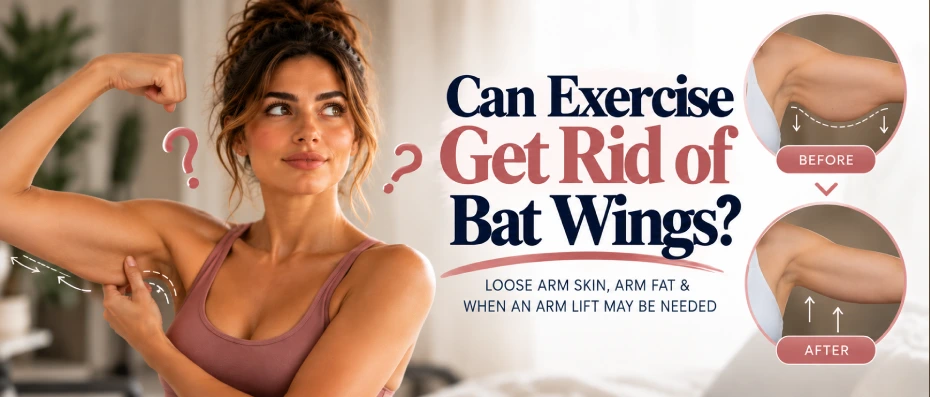
Exercise can strengthen and shape the muscles of the upper arms and may contribute to overall fat loss, but it cannot remove significant excess skin.
This is the most important distinction when talking about what people commonly call “bat wings.”
The hanging tissue underneath the upper arm can come from three different things:
- Excess fat
- Loose or stretched skin
- A combination of fat and loose skin
Exercise can change muscle.
Weight loss can change fat.
But once there is a significant amount of redundant skin, exercise cannot physically remove that skin.
That is why someone can lose a large amount of weight, become physically fit and develop strong triceps while still having loose tissue hanging underneath the arms.
The question is therefore not simply:
“Which exercise gets rid of bat wings?”
A better question is:
“Are my bat wings caused by fat, loose skin or both?”
That answer determines what can realistically improve them.
Quick Answer: What Actually Gets Rid of Bat Wings?
The right approach depends on whether the upper-arm fullness comes mainly from fat, skin laxity or both.
| Main Concern | What May Help |
|---|---|
| Weak or poorly defined muscle | Resistance training |
| General excess body fat | Overall fat loss |
| Localized upper-arm fat + good skin elasticity | Liposuction may be considered |
| Mild skin laxity | Selected skin-tightening treatments may provide improvement |
| Significant hanging skin | Arm lift / brachioplasty |
| Significant loose skin + excess fat | Brachioplasty with fat reduction in selected patients |
This distinction matters because treating the wrong problem can produce disappointing results.
For example, removing fat from an arm with already significant loose skin does not remove the skin itself.
What Are “Bat Wings” on the Arms?
“Bat wings” is a non-medical term commonly used to describe loose, hanging or mobile tissue underneath the upper arms.
The medical problem can vary considerably from person to person.
For one patient, the arm may mainly contain excess subcutaneous fat.
Another may have relatively little fat but substantial loose skin after major weight loss.
Another may have moderate fat combined with age-related skin laxity.
The arms may appear:
- Full
- Loose
- Deflated
- Wrinkled
- Saggy
- Heavy underneath
- Mobile when waving or raising the arms
Because these appearances have different causes, there is no single treatment called a “bat wing treatment.”
Why Do People Get Bat Wings?
Sagging upper arms usually develop because of changes in fat volume, skin elasticity, aging, genetics or substantial weight loss.
The skin has elastic properties, but its ability to retract is not unlimited.
Common contributors include:
Aging
Skin and supporting tissues change with age, which can contribute to laxity.
Significant weight loss
When an arm has carried considerably more volume, the skin has been stretched around that larger circumference.
After the fat decreases, the skin may not fully contract.
Genetics
People naturally differ in where they store fat and in their skin and tissue characteristics.
Changes in body weight
Repeated expansion and reduction of the tissues may affect the appearance of the upper arms.
Loss of skin elasticity
If skin cannot adequately contract around a smaller arm volume, loose tissue remains.
Usually, several of these factors occur together.
Why Do I Have Bat Wings Even Though I’m Not Overweight?
You can have sagging upper arms at a healthy body weight because bat wings are not always caused by excess fat.
This is one of the biggest misconceptions.
Someone may be:
- Slim
- Physically active
- At a stable weight
- Muscular
and still have loose upper-arm skin.
If the primary problem is skin laxity, losing more weight may not solve it.
In some cases, further fat loss can actually make existing skin laxity more visible because there is less underlying volume filling the skin envelope.
Can Exercise Tighten Loose Arm Skin?
Exercise can improve the muscle underneath loose arm skin, but it cannot directly remove significant redundant skin.
Resistance training may increase:
- Triceps strength
- Biceps strength
- Shoulder definition
- Overall upper-arm muscular contour
This can improve how the arm looks.
But muscle growth and skin removal are fundamentally different processes.
If a fold of excess skin hangs beneath the arm, stronger triceps do not surgically remove that fold.
This is why some patients say:
“My arms are much stronger, but the skin still hangs.”
That can be completely consistent with the underlying anatomy.
Can Tricep Exercises Get Rid of Bat Wings?
Tricep exercises can strengthen and develop the back of the upper arm, but they cannot reliably eliminate bat wings caused by loose skin.
Useful triceps exercises may include:
- Tricep extensions
- Push-ups
- Dips
- Resistance-band exercises
- Cable exercises
- Pressing movements
These exercises have genuine fitness benefits.
But they should not be advertised as a method of removing excess skin.
If the hanging appearance is primarily due to underdeveloped muscle, resistance training may make a meaningful aesthetic difference.
If it is primarily loose skin, the improvement will be limited.
Can You Tone Saggy Arms?
You can improve muscle tone and arm definition, but “toning” does not mean that excess skin disappears.
The word tone is often used to describe several completely different changes:
- Building muscle
- Losing fat
- Improving visible definition
- Tightening skin
These are not interchangeable.
Resistance training affects muscle.
Energy balance influences body fat.
Skin elasticity is a separate biological issue.
Therefore, someone can achieve excellent muscle tone while still having skin laxity.
Can Lifting Weights Get Rid of Loose Arm Skin?
Weight training can improve the shape underneath loose skin but cannot remove substantial excess skin.
Increasing muscle volume may make some mild laxity appear less noticeable.
However, there is a limit.
Muscle should not be viewed as a way to “fill out” a large amount of redundant skin after significant weight loss.
For patients with substantial skin excess, the anatomical problem remains even when the muscles are strong.
Can Push-Ups Get Rid of Bat Wings?
Push-ups can strengthen the upper body and triceps but cannot specifically remove hanging upper-arm skin.
Push-ups train multiple muscles, including the:
- Chest
- Triceps
- Shoulders
They are excellent exercises when appropriate for the individual.
But there is no specific number of push-ups that causes redundant arm skin to disappear.
Can Exercise Burn Upper-Arm Fat?
Exercise can help reduce overall body fat, but reliably choosing exactly where fat will disappear first remains difficult.
This area deserves some scientific nuance.
The traditional fitness claim is that spot reduction does not exist at all.
More recent small randomized studies have challenged such an absolute statement and reported localized fat changes under specific exercise protocols.
However, this evidence is limited, involves small study populations and has largely examined regions such as the abdomen—not a reliable method for selectively removing upper-arm fat.
Therefore, the practical advice remains:
Doing tricep exercises should not be expected to selectively remove the fat underneath your arms.
Overall body composition, genetics and fat distribution remain important.
Can You Target Arm Fat Specifically?
There is currently no reliable exercise prescription that allows you to choose precisely how much fat your upper arms will lose.
Your body determines fat distribution according to multiple biological factors.
Two people can lose the same amount of body weight and experience very different changes in their:
- Abdomen
- Thighs
- Face
- Breasts
- Arms
Exercise remains valuable for health, strength and body composition.
It simply should not be marketed as precise surgical-style contouring.
Why Won’t My Arm Fat Go Away?
Persistent upper-arm fullness can result from genetics, overall body-fat distribution, localized subcutaneous fat or loose skin that is mistaken for fat.
This last point is particularly important.
Patients sometimes pinch the hanging area and assume:
“This is all fat.”
But the tissue may contain:
- Skin
- Fat
- Connective tissue
If the skin itself is significantly lax, losing additional fat may not create the tight arm contour the patient expects.
Why Do I Still Have Bat Wings After Losing Weight?
After significant weight loss, the fat may decrease substantially while stretched upper-arm skin remains.
This is one of the classic reasons patients consider brachioplasty.
Imagine a balloon that has been expanded for a long time.
Reducing what is inside does not necessarily return the outer envelope perfectly to its original dimensions.
Human skin is much more complex than a balloon, but the basic concept helps explain why:
less fat does not automatically mean less loose skin.
Post-weight-loss arm contour can therefore include:
- Hanging skin
- Residual fat
- Deflated tissue
- Wrinkling
- Skin folds
- Extension of excess tissue toward the armpit or lateral chest
Recent reviews of arm contouring after massive weight loss continue to identify surgical skin and fat removal as important approaches for significant deformity.
Will Loose Arm Skin Tighten After Weight Loss?
Some skin retraction may occur after weight loss, but the amount is highly individual and significant excess skin may persist.
Skin behavior can be influenced by factors such as:
- Age
- Genetics
- Amount of previous stretching
- Magnitude of weight loss
- Tissue characteristics
- Weight stability
There is no reliable formula that predicts exactly how much an individual’s upper-arm skin will retract.
This is why it can be reasonable to allow the body and weight to stabilize before deciding whether residual skin requires treatment.
How Long Should I Wait for Skin to Tighten After Weight Loss?
There is no universal number of months after which all upper-arm skin has completed its natural retraction.
For patients considering body-contouring surgery after major weight loss, the broader goal is usually to reach a reasonably stable weight and allow the body to stabilize.
The appropriate timing depends on:
- How the weight was lost
- Whether weight is still changing
- General health
- Nutritional status
- Planned procedures
- Individual tissue characteristics
The decision should therefore be individualized rather than based on an internet countdown.
Will Losing More Weight Get Rid of Bat Wings?
Losing additional weight may reduce residual arm fat, but it will not necessarily eliminate loose skin and may make skin laxity more visible.
This is why it is important to distinguish:
A large arm because of fat
from:
A loose arm because of redundant skin
If someone is already at an appropriate, stable weight and the primary concern is hanging skin, repeatedly trying to lose more weight may not solve the actual problem.
Can Diet Get Rid of Bat Wings?
Nutrition can support overall fat loss when a calorie deficit is appropriate, but diet cannot selectively remove upper-arm skin.
Diet and exercise are fundamental for general health and weight management.
They are not substitutes for surgical skin excision when significant redundant skin is present.
How Can I Tell If My Bat Wings Are Fat or Loose Skin?
A clinical examination is the most reliable way to determine whether the upper-arm concern is primarily fat, skin laxity or both.
As a general concept:
More likely to involve significant fat
The arm appears full and has substantial subcutaneous thickness, while the skin retains relatively good elasticity.
More likely to involve significant loose skin
The arm looks deflated, wrinkled or hangs significantly, especially when raised away from the body.
Combination
The patient has both persistent fat volume and hanging skin.
Many patients fall into this third category.
This distinction is important because it determines whether liposuction, skin removal or a combination makes more sense.
Can Liposuction Get Rid of Bat Wings?
Liposuction can reduce localized upper-arm fat in selected patients, but it does not remove significant excess skin.
The best liposuction candidates for the arms generally have:
- Localized fat
- Reasonably good skin quality
- Limited skin laxity
- Appropriate expectations
The skin must be able to adapt to the reduced volume.
If it cannot, removing fat may leave loose skin behind.
Can Arm Liposuction Make Loose Skin Worse?
If significant skin laxity already exists, reducing the underlying fat volume can make that laxity more noticeable.
This does not mean liposuction always worsens the arms.
It means patient selection matters.
The American Society of Plastic Surgeons similarly distinguishes between patients whose primary concern is fat and those with significant excess skin, for whom excisional surgery may be more appropriate.
That is why an arm should not be evaluated simply by asking:
“Is there fat I can remove?”
The more important question is:
“What will the skin do after that fat is removed?”
Liposuction vs Arm Lift: What’s the Difference?
Liposuction primarily removes fat, while an arm lift removes excess skin and can also address fat when necessary.
Arm Liposuction
More appropriate when:
- Fat is the main concern
- Skin elasticity is relatively good
- There is limited sagging
Arm Lift / Brachioplasty
More appropriate when:
- Hanging skin is the main concern
- Skin laxity is significant
- Weight loss has left redundant tissue
- Fat reduction alone would not create the desired contour
Combined approach
Some patients have enough fat and skin excess that both need to be addressed.
There is no universally superior option.
They treat different anatomical problems.
What Is an Arm Lift?
An arm lift, medically called brachioplasty, surgically removes excess upper-arm skin and reshapes the arm contour.
According to the American Society of Plastic Surgeons, brachioplasty reshapes the underside of the upper arm from the underarm region toward the elbow.
Depending on the patient’s anatomy, surgery can involve:
- Removal of excess skin
- Removal of selected fatty tissue
- Liposuction in selected cases
- Reshaping of the underlying tissues
The extent of surgery depends on how much excess tissue exists and where it is located.
Can an Arm Lift Completely Remove Bat Wings?
Brachioplasty can substantially improve significant hanging upper-arm skin, but no operation can promise perfectly tight, scar-free or permanently unchanging arms.
The procedure can create a major contour improvement when loose skin is the dominant problem.
However, patients must understand the central trade-off:
Loose skin is exchanged for a surgical scar.
For many patients, that trade-off is worthwhile.
For others, the scar may be more concerning than the loose skin.
Neither choice is wrong.
It depends on individual priorities.
Does an Arm Lift Leave a Scar?
Yes. An arm lift necessarily creates a scar because excess skin must be surgically removed through an incision.
The incision pattern depends on:
- Amount of excess skin
- Location of the excess
- Whether laxity extends toward the armpit or chest
- Surgical technique
The American Society of Plastic Surgeons notes that incisions are commonly positioned along the inside or back of the upper arm and may extend from the underarm toward the elbow in more extensive cases.
Limited skin excess may allow shorter incisions.
But significant bat wings cannot be removed without accepting some form of scar.
Where Is the Arm Lift Scar?
The scar is commonly positioned along the inner or posteromedial upper arm, although its exact location and length depend on the surgical plan.
Recent literature reviewing post-weight-loss brachioplasty describes both medial and posteromedial scar placement.
No scar position makes the scar completely invisible.
The objective is to balance:
- Maximum contour improvement
- Appropriate skin removal
- Acceptable scar placement
Scar quality also varies between patients.
Is an Arm Lift Worth the Scar?
Whether the contour improvement justifies the scar is a personal decision and one of the most important parts of an arm lift consultation.
A patient with a very small amount of skin laxity may decide that a long scar is not a reasonable trade-off.
Someone with substantial hanging tissue after major weight loss may feel completely differently.
The question is not simply:
“Will there be a scar?”
There will.
The better question is:
“Is the amount of improvement I can realistically achieve worth that scar to me?”
What Are the Risks of an Arm Lift?
Brachioplasty can significantly improve upper-arm contour, but it has recognized surgical risks and wound-healing complications.
A 2022 systematic review and meta-analysis included 29 studies and 1,578 patients.
Reported pooled complications included approximately:
- 9.9% aberrant scarring
- 7.8% ptosis or recurrence
- 6.8% wound dehiscence
- 5.9% seroma
- 3.6% infection
- 2.5% nerve-related complications
- 2.5% lymphedema or lymphocele
- 2.3% skin necrosis or delayed healing
- 2.1% hematoma
These are pooled research estimates—not a prediction of an individual patient’s risk.
Personal risk depends on health, procedure extent, surgical technique and other factors.
Can Loose Arm Skin Be Tightened Without Surgery?
Mild upper-arm skin laxity may improve with selected non-surgical or minimally invasive skin-tightening technologies, but these treatments cannot reliably reproduce surgical removal of substantial excess skin.
Radiofrequency-based treatments are one example.
Research has reported improvements in skin laxity with some RF technologies, including small studies specifically involving the upper arms.
However, systematic reviews have also highlighted important limitations:
- Small studies
- Different devices
- Different treatment parameters
- Variable outcome measurements
- Limited long-term evidence
Therefore, skin tightening should be discussed realistically.
Mild laxity and significant hanging skin are not the same problem.
Can Radiofrequency Tighten Bat Wings?
Radiofrequency may improve mild to moderate skin laxity in selected patients, but it should not be expected to remove a large fold of redundant upper-arm skin.
One prospective study evaluating subdermal radiofrequency in 12 patients with posterior upper-arm laxity reported improvements at short-term follow-up.
That is encouraging.
But 12 patients do not establish that RF is equivalent to brachioplasty.
The amount of skin excess matters.
Can Non-Surgical Skin Tightening Replace an Arm Lift?
Not when substantial redundant skin needs to be physically removed.
This is where realistic expectations become essential.
Energy-based treatments aim to stimulate tissue contraction or remodeling.
Brachioplasty actually removes tissue.
Those are fundamentally different mechanisms.
For mild laxity, the less invasive option may be attractive.
For significant hanging skin, accepting a smaller improvement simply to avoid a scar may not satisfy the patient’s goal.
Can Muscle Fill Out Loose Arm Skin?
Building upper-arm muscle may improve contour and make mild laxity less noticeable, but muscle growth cannot reliably fill a large skin envelope left after significant weight loss.
Strength training remains beneficial.
It simply has anatomical limitations.
Someone should not feel that persistent loose skin means their exercise program has failed.
The exercise may have done exactly what it was supposed to do:
build muscle and improve fitness.
The remaining problem may simply be skin.
What Is the Best Exercise for Bat Wings?
There is no single exercise that removes bat wings, but resistance exercises targeting the triceps, shoulders and upper body can improve strength and muscular definition.
Examples include:
- Tricep extensions
- Push-ups
- Dips
- Overhead presses
- Rows
- Resistance-band exercises
The appropriate program depends on health, fitness level and physical limitations.
The goal of these exercises should be muscular development—not a promise that they will remove excess skin.
Can Bat Wings Come Back After an Arm Lift?
Arm-lift surgery removes existing excess tissue, but it cannot stop future aging or changes caused by substantial weight fluctuations.
Maintaining a relatively stable weight can help preserve the result.
Over time, however:
- Skin ages
- Tissues change
- Weight may fluctuate
Some degree of recurrent laxity can therefore develop.
An arm lift improves the existing contour.
It does not make the tissues immune to future biological change.
Should I Lose Weight Before an Arm Lift?
If significant additional weight loss is planned, it is generally useful to discuss reaching a more stable weight before definitive body-contouring surgery.
Why?
Because losing substantial weight after surgery can create new loose skin and alter the surgical result.
But there is no universal number on the scale that determines arm-lift eligibility.
Assessment should include:
- Weight stability
- General health
- Nutritional status
- Smoking/nicotine use
- Medical history
- Amount of excess skin
- Surgical goals
Can an Arm Lift Be Combined With Liposuction?
Yes. Brachioplasty can be combined with fat reduction in selected patients when both excess skin and fat contribute to the upper-arm contour.
However, combining procedures changes the surgical plan and may affect complication risk.
Research in post-weight-loss patients has specifically examined brachioplasty combined with liposuction and other body-contouring procedures.
Therefore, combination treatment should be selected according to anatomy and safety rather than automatically performed on everyone.
Can an Arm Lift Be Done After Massive Weight Loss?
Yes. Significant weight loss is one of the most common reasons patients consider brachioplasty.
After major weight loss, excess skin may extend beyond the upper arm into:
- The armpit
- Lateral chest
- Upper back
This can require more extensive planning than a small isolated upper-arm lift.
A 2025 literature review of arm contouring after massive weight loss found multiple excisional and liposuction-assisted techniques, reflecting how variable post-weight-loss anatomy can be.
How Do I Know If I Need an Arm Lift or Just Exercise?
If the main issue is muscle definition or overall body fat, lifestyle changes may still produce meaningful improvement; if substantial hanging skin remains at a stable weight, exercise alone is unlikely to remove it.
A useful way to think about the problem is:
Muscle problem?
Train it.
Overall fat problem?
Address body composition.
Localized fat with good skin?
Liposuction may be an option.
Mild skin laxity?
Selected tightening treatments may be considered.
Significant excess skin?
Discuss brachioplasty.
Real patients frequently have more than one of these problems at the same time.
Arm Lift in Istanbul: How Are Bat Wings Evaluated?
For patients considering an arm lift in Istanbul, Turkey, the first step should be identifying what actually creates the unwanted upper-arm contour.
Dr. Burak Pasinlioğlu, a European Board Certified Plastic Surgeon (EBOPRAS) based in Istanbul, Turkey, evaluates factors including:
- Amount of excess skin
- Amount and distribution of upper-arm fat
- Skin elasticity
- Previous weight loss
- Weight stability
- Whether excess tissue extends into the armpit or chest
- Existing scars
- Overall health
- Desired contour
- The scar required to achieve that contour
Depending on the anatomy, options may include:
- No surgery
- Liposuction
- Selected skin-tightening approaches
- Limited-incision arm lift
- Traditional brachioplasty
- Brachioplasty combined with fat reduction
The correct procedure depends on the problem.
Fat and excess skin should not automatically be treated as if they are the same thing.
Frequently Asked Questions About Bat Wings and Loose Arm Skin
Can exercise get rid of bat wings?
Exercise can strengthen and shape upper-arm muscles, but it cannot remove significant excess skin. Whether bat wings improve with exercise depends on whether the main problem is muscle, fat or loose skin.
Can tricep exercises get rid of bat wings?
Tricep exercises can improve muscle definition but cannot physically remove redundant skin.
Can you tone bat wings?
You can tone the underlying muscles and reduce overall body fat, but significant loose skin may remain.
Can weights tighten loose arm skin?
Weight training can improve the muscular contour underneath the skin, but it does not directly remove excess skin.
Can push-ups get rid of bat wings?
Push-ups strengthen the chest, shoulders and triceps but cannot remove hanging upper-arm skin.
How many tricep exercises should I do to get rid of bat wings?
There is no number of tricep exercises proven to remove redundant skin. Exercise prescription should be based on fitness goals rather than a promise of skin removal.
Can I target upper-arm fat with exercise?
Exercise can contribute to fat loss, but there is no reliable method that allows you to precisely choose how much fat your upper arms will lose.
Does spot reduction work for arm fat?
Evidence on localized exercise-induced fat loss is evolving, but current studies do not provide a reliable method for selectively eliminating upper-arm fat through arm exercises alone.
Why are my arms still flabby after exercising?
The remaining tissue may be loose skin, residual fat or both. Stronger muscles do not necessarily eliminate the tissues covering them.
Why do I have bat wings if I’m skinny?
Bat wings can result from skin laxity rather than excess body fat, so slim people can still have sagging upper arms.
Why do my arms sag as I get older?
Age-related changes in skin and supporting tissues can reduce firmness and contribute to upper-arm laxity.
Why do I have loose arm skin after weight loss?
The skin may have been stretched around a larger arm and may not completely contract after the underlying volume decreases.
Will loose skin tighten naturally after weight loss?
Some retraction may occur, but the amount varies considerably and significant redundant skin may persist.
How long does loose skin take to tighten after weight loss?
There is no universal timeline. Skin response depends on individual tissue characteristics, age, weight change and other factors.
Will losing more weight get rid of loose arm skin?
Not necessarily. Additional weight loss can reduce fat but cannot guarantee skin contraction and may make laxity more visible.
Does loose skin mean I still have arm fat?
No. Loose skin and excess fat are different problems, although they frequently occur together.
How can I tell if my arms are fat or loose skin?
An examination can assess skin elasticity, subcutaneous fat thickness and the amount of redundant tissue.
Can diet get rid of bat wings?
Diet can contribute to overall fat loss when appropriate, but it cannot selectively remove excess upper-arm skin.
Can arm fat disappear with weight loss?
Upper-arm fat can decrease with overall weight loss, but the amount varies between individuals.
Can liposuction remove bat wings?
Liposuction can reduce localized arm fat in appropriately selected patients but cannot remove significant hanging skin.
Can arm liposuction tighten skin?
Some skin may retract after fat removal when elasticity is good, but liposuction should not be considered a reliable method for removing significant excess skin.
Can liposuction make my arms look more saggy?
If substantial skin laxity already exists, reducing the underlying fat may make that laxity more apparent.
Arm liposuction or arm lift: which is better?
Neither is universally better. Liposuction primarily treats fat; an arm lift treats significant excess skin.
What is an arm lift?
An arm lift, or brachioplasty, surgically removes excess upper-arm skin and reshapes the arm contour.
Does an arm lift remove fat too?
It can. Excess fat may be directly removed or treated with liposuction when appropriate.
Does an arm lift leave a scar?
Yes. Removing excess skin requires an incision and therefore produces a permanent scar.
Where is an arm lift scar?
It is commonly positioned along the inner or back/inner portion of the upper arm and may extend from the armpit toward the elbow depending on the amount of skin removed.
Can you have an arm lift without a long scar?
Patients with limited skin excess may sometimes qualify for a shorter-incision approach, but significant hanging skin generally requires a longer incision to remove it adequately.
Is an arm lift scar worth it?
That is an individual decision. The central trade-off of brachioplasty is improved contour in exchange for a permanent scar.
Can an arm lift remove all loose skin?
Brachioplasty can remove substantial excess skin, but perfectly tight, scar-free arms cannot be guaranteed.
What are the risks of an arm lift?
Recognized risks include abnormal scarring, wound separation, seroma, infection, hematoma, sensory or nerve-related changes, delayed healing and recurrent laxity, among other surgical risks.
Can non-surgical treatment get rid of bat wings?
Selected treatments may improve mild laxity, but they cannot reliably reproduce surgical removal when substantial skin excess is present.
Does radiofrequency work for saggy arms?
Some studies report improvements in upper-arm skin laxity with radiofrequency, but results depend on technology and patient selection, and the evidence is not equivalent to surgical skin removal.
Can skin tightening replace an arm lift?
Not when there is substantial redundant skin that needs to be physically removed.
Can I build enough muscle to fill loose arm skin?
Muscle development can improve arm shape but cannot reliably compensate for a large amount of redundant skin after major weight loss.
What is the fastest way to get rid of bat wings?
There is no universally appropriate “fastest” treatment. The correct option depends on whether the problem is fat, skin or both.
What is the best treatment for bat wings?
The best treatment is determined by the anatomy. Exercise may address muscle, weight management may reduce fat, liposuction may address localized fat, and brachioplasty may address significant excess skin.
Do I need an arm lift after losing a lot of weight?
Not everyone does. An arm lift becomes relevant when significant excess skin remains and the patient considers the contour improvement worth the scar.
Should I lose more weight before an arm lift?
If substantial additional weight loss is planned, reaching a more stable weight may help create a more predictable body-contouring plan.
Can an arm lift and liposuction be done together?
Yes, in selected patients with both excess skin and fat, but the combined procedure must be planned according to anatomy and individual surgical risk.
Can bat wings return after an arm lift?
Some laxity can develop again with aging or significant weight fluctuations, although the excess tissue removed during surgery does not simply regenerate in its previous form.
Can men get bat wings?
Yes. Upper-arm fat and loose skin can affect both women and men, particularly after significant weight loss or with aging.
Can I avoid an arm lift if I exercise enough?
Exercise is beneficial, but if significant redundant skin is the main problem, additional exercise cannot physically remove that skin.
Medical References
- American Society of Plastic Surgeons — Arm Lift Procedure. Overview of brachioplasty, including removal of excess skin, incision patterns and the role of liposuction in selected patients.
https://www.plasticsurgery.org/cosmetic-procedures/arm-lift/procedure
- American Society of Plastic Surgeons — Arm Lift vs Liposuction for the Upper Arms. 2026. Contemporary clinical discussion distinguishing localized upper-arm fat from significant skin laxity and explaining when liposuction or excisional surgery may be appropriate.
- Aljerian A, et al. Complications in Brachioplasty: A Systematic Review and Meta-Analysis. Plastic and Reconstructive Surgery. 2022. Meta-analysis of 29 studies involving 1,578 patients evaluating scarring, wound dehiscence, seroma, infection and other brachioplasty complications.
https://pubmed.ncbi.nlm.nih.gov/34936607
- Arm Contouring in Patients With Massive Weight Loss: A Literature Review. 2025. Review of upper-arm contouring after major weight loss, including excisional and liposuction-assisted brachioplasty techniques and scar placement.
https://pubmed.ncbi.nlm.nih.gov/41000426
- Milone M, et al. Complications Associated With Brachioplasty: A Literature Review. 2018. Review of brachioplasty techniques, outcomes and complications.
https://pubmed.ncbi.nlm.nih.gov/29350652
- Gusenoff JA, Coon D, Rubin JP. Brachioplasty and Concomitant Procedures After Massive Weight Loss: A Statistical Analysis From a Prospective Registry. Plastic and Reconstructive Surgery. 2008. Prospective registry analysis evaluating brachioplasty, concomitant body-contouring procedures and postoperative complications.
https://pubmed.ncbi.nlm.nih.gov/18626379
- Zomerlei TA, et al. Brachioplasty Outcomes: A Review of a Multipractice Cohort. Plastic and Reconstructive Surgery. 2013. Clinical review of brachioplasty performed for upper-arm deformity associated with massive weight loss and age-related tissue laxity.
https://pubmed.ncbi.nlm.nih.gov/23542260
- Brobakken MFF, et al. Abdominal Aerobic Endurance Exercise Reveals Spot Reduction Exists: A Randomized Controlled Trial. Physiological Reports. 2023. Small randomized study challenging the absolute claim that localized exercise-induced fat reduction is impossible; its findings should not be extrapolated into a proven method for selectively removing upper-arm fat.
https://pubmed.ncbi.nlm.nih.gov/38010201
- Effect of an Endurance and Strength Mixed Circuit Training on Regional Fat Thickness: The Quest for the “Spot Reduction.” 2021. Small study examining localized subcutaneous fat changes with combined exercise protocols, illustrating the evolving but still limited evidence surrounding spot reduction.
https://pubmed.ncbi.nlm.nih.gov/33917584
- Subdermal Radiofrequency for Skin Tightening of the Posterior Upper Arms. 2016. Prospective study of 12 patients reporting short-term improvement in posterior upper-arm skin laxity following subdermal radiofrequency treatment.
https://pubmed.ncbi.nlm.nih.gov/27560292
- Rezapour A, et al. Safety and Effectiveness of Endodermal Radiofrequency for Skin Rejuvenation: A Systematic Review. Aesthetic Plastic Surgery. 2023. Systematic review evaluating radiofrequency-based approaches for skin laxity and body contouring.
https://pubmed.ncbi.nlm.nih.gov/36178511
- Radiofrequency for the Treatment of Skin Laxity: Myth or Truth. Review highlighting reported collagen and skin-laxity effects while also noting heterogeneity and limitations in the quality of the evidence.
https://pubmed.ncbi.nlm.nih.gov/26560216
Medical Disclaimer: This article is intended for general educational purposes and does not determine whether an individual needs weight loss, liposuction, skin-tightening treatment or brachioplasty. Upper-arm contour and skin laxity should be assessed individually, and any surgical procedure requires evaluation of medical history, anatomy, expectations and personal risk factors.