


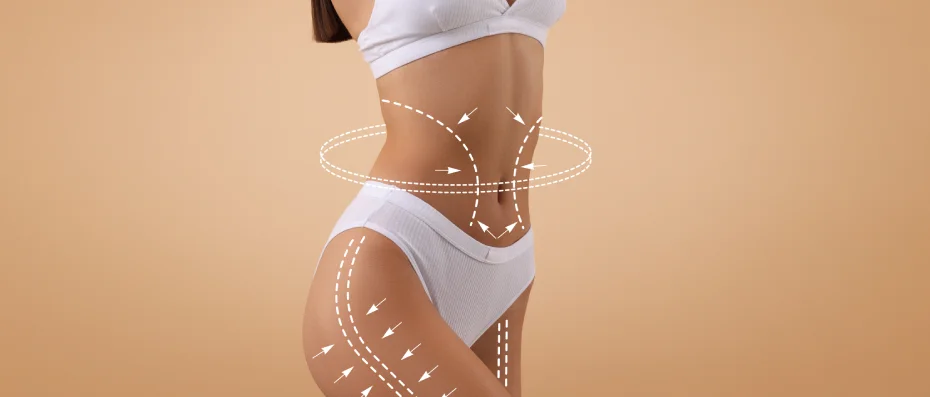
You have liposuction, the unwanted fat is removed, and after the swelling settles you finally see a more defined abdomen, waist, thighs or another treated area.
Then comes the obvious question:
“Is liposuction permanent?”
You may have heard two completely different answers.
“Yes. Once fat cells are removed, they’re gone forever.”
And:
“No. The fat eventually comes back.”
Surprisingly, both statements are trying to describe part of the same process—but neither tells the full story.
The most accurate answer is:
Liposuction permanently removes a proportion of fat cells from the treated area. Those removed fat cells do not simply grow back. However, liposuction does not permanently guarantee your body shape because remaining fat cells can enlarge if you gain weight, and your body will continue to change with aging, hormones and lifestyle. The American Society of Plastic Surgeons (ASPS) describes liposuction results as long-lasting when patients maintain a stable weight and general fitness.
So the surgery can create a lasting anatomical change.
But it does not freeze your body in time.
Let’s explain exactly what that means.
Is Liposuction Permanent?
Yes—the fat cells physically removed during liposuction are permanently removed.
Liposuction uses a cannula to remove selected deposits of subcutaneous fat, the fat located beneath your skin.
Once those fat cells have been removed from your body, they don’t simply refill months or years later.
Histological research examining tissue after liposuction has also found no evidence of reparative proliferation of the residual fat cells in the studied tissue.
But there is an important distinction:
Permanent fat-cell removal does not mean permanent protection against future fat gain.
You still have fat cells remaining throughout your body—including in the areas that underwent liposuction.
Those cells can change.
Can Fat Grow Back After Liposuction?
The fat cells removed during liposuction do not simply grow back, but you can accumulate fat again if you gain weight.
This is one of the most misunderstood parts of liposuction.
Imagine that an area contains a certain number of fat cells before surgery.
Liposuction removes a proportion of them.
After surgery, there are fewer fat cells in that area—but there are still fat cells remaining.
If you maintain approximately the same weight, the improvement in body contour can remain long-term.
If you gain weight, however, the remaining fat cells can enlarge.
ASPS explains that even with modest weight gain, the treated area still has fewer fat cells than before, so the improved proportions may remain visible. Larger weight increases can make the original result progressively less noticeable.
This means:
Your liposuction hasn’t “reversed.”
Your body has simply changed after the surgery.
How Long Do Liposuction Results Last?
Liposuction results can last for many years when body weight remains relatively stable.
ASPS states that liposuction results should be long-lasting provided that a patient maintains a stable weight and general fitness. Natural aging can reduce tissue firmness over time, but much of the contour improvement can remain.
There isn’t a countdown where your liposuction suddenly expires after:
- 5 years
- 10 years
- 15 years
The procedure doesn’t have an expiration date.
Instead, the long-term appearance depends heavily on what happens to your body afterward.
That includes:
- Weight changes
- Aging
- Skin elasticity
- Hormonal changes
- Lifestyle
- Physical activity
- Pregnancy
- Genetics
A person who remains near a stable weight may preserve the contour change for many years.
Someone who experiences substantial weight fluctuations may see a much larger change.
What Happens 10 Years After Liposuction?
The fat cells removed during your original liposuction are still removed 10 years later, but your body may look different because ten years of aging and possible weight changes have occurred.
This is an important distinction.
Your body at 45 is not necessarily going to look exactly like your body at 35—even if you weigh exactly the same.
Skin elasticity changes.
Fat distribution can change with age.
Hormonal changes can influence body composition.
Muscle mass can change.
Research examining human adipose tissue over long periods has also demonstrated age-related changes in lipid turnover, illustrating that fat tissue remains biologically dynamic throughout adulthood.
So if your body changes years after liposuction, that does not necessarily mean the procedure stopped working.
Your surgery can be permanent while your body continues aging.
What Happens If You Gain Weight After Liposuction?
This is where the meaning of “permanent” becomes particularly important.
You can absolutely gain weight after liposuction.
Liposuction doesn’t change your body’s basic ability to store energy.
It is a body-contouring operation—not a treatment that prevents future weight gain.
If you gain a small amount of weight, remaining fat cells throughout your body can become slightly larger.
Your liposuction result may still remain visible because the treated area contains fewer fat cells than before surgery.
If you gain a substantial amount of weight, the change can become much more obvious.
Treated areas can become fuller.
Untreated areas can enlarge.
Your waistline can change.
Your body proportions can change.
Eventually, enough weight gain can significantly reduce the visual benefit of the original liposuction.
Will Gaining 5 or 10 Pounds Ruin Liposuction?
Not necessarily.
There isn’t a universal number of pounds or kilograms at which liposuction results suddenly disappear.
Five pounds on one person can represent a very different proportional change than five pounds on another.
ASPS specifically notes that modest postoperative weight gain may diminish the result somewhat while still allowing the improved body proportions to remain visible.
The more useful question is therefore:
“Has my weight changed enough to meaningfully alter my body proportions?”
rather than:
“How many pounds am I allowed to gain?”
Normal weight fluctuations happen.
The goal isn’t perfection.
It is long-term stability.
If Fat Cells Are Gone, Where Does New Fat Go?
This is one of the most interesting questions surrounding liposuction.
If fewer fat cells remain in a treated area, what happens when you gain weight?
Remaining fat cells throughout the body can enlarge.
But the idea that fat will automatically “move” from the liposuction area to another specific body part is too simplistic.
Research on fat redistribution after liposuction has not produced completely uniform results.
One randomized controlled trial in non-obese women found restoration of body fat over one year following small-volume liposuction, with redistribution occurring predominantly toward the abdominal region.
Another study examining 301 liposuction and abdominoplasty cases found lasting reductions in treated areas and no evidence of upper-body redistribution; among the subgroup with at least one year of follow-up, there was no evidence of fat reaccumulation.
So it would be inaccurate to tell every patient:
“If you remove fat from your stomach, you’ll gain it in your arms.”
The body’s regulation and distribution of fat is more complex.
Can Fat Return to the Same Area After Liposuction?
The treated area can become larger again, even though the original removed fat cells haven’t returned.
Why?
Because liposuction never removes every fat cell.
The cells remaining in the treated area can enlarge if you gain weight.
With considerable weight gain, ASPS patient information also notes that new fat cells can potentially develop throughout the body, including treated areas. Even then, treated regions generally retain fewer fat cells relative to their preoperative state.
This is why saying:
“Fat can never return to a liposuction area.”
is too absolute.
A more accurate statement is:
The surgically removed fat cells don’t return, but the treated area can accumulate fat again if your body weight changes significantly.
Does Liposuction Permanently Change Where You Store Fat?
Not in a completely predictable way.
Liposuction changes the number and distribution of fat cells in selected areas, so it can change your proportions.
But your future fat-storage pattern is still influenced by:
- Genetics
- Hormones
- Age
- Sex
- Lifestyle
- Overall weight change
Scientific studies investigating compensatory fat accumulation after liposuction have produced differing findings.
So patients shouldn’t be told that future fat is guaranteed to appear in one particular location.
Does Liposuction Permanently Remove Belly Fat?
Liposuction can permanently remove some subcutaneous belly fat, but it cannot remove all abdominal fat.
There are two important types of abdominal fat to understand.
Subcutaneous Fat
This is the softer fat underneath your skin.
It is the fat liposuction can target.
Visceral Fat
This is located deeper inside your abdominal cavity around your internal organs.
Liposuction cannot remove visceral fat.
This distinction matters because someone can have successful abdominal liposuction and later notice that their stomach looks larger.
That does not automatically mean the liposuction has reversed.
They may have:
- Gained subcutaneous fat
- Increased visceral fat
- Developed more skin laxity
- Experienced changes in abdominal musculature
- Gained weight overall
One randomized study found that abdominal subcutaneous fat reduction remained after liposuction at six months, while sedentary participants developed an increase in visceral fat; this increase was counteracted in the exercise group.
So the abdomen can change after liposuction for reasons that have nothing to do with the removed fat cells returning.
Is Lipo 360 Permanent?
The fat cells removed during Lipo 360 are permanently removed in the same way as with other forms of liposuction.
Lipo 360 generally describes circumferential contouring around areas such as the:
- Abdomen
- Waist
- Flanks
- Back
The “360” does not make the procedure biologically more permanent than conventional liposuction.
Long-term results still depend heavily on maintaining relatively stable body weight.
Significant future weight gain can change the contour even after extensive circumferential liposuction.
Is Liposuction Permanent If You Exercise?
Exercise doesn’t make removed fat cells more permanent.
They’re already removed.
What exercise can do is support weight management, general fitness and body composition.
A randomized controlled study of women undergoing abdominal liposuction found that physical activity counteracted the increase in visceral fat observed in the non-exercise group during follow-up.
That does not mean every patient must follow one specific exercise routine to maintain liposuction.
It does reinforce a broader point:
Surgery can change your contour, but lifestyle continues to influence your body afterward.
Does Liposuction Permanently Make You Lose Weight?
No. Liposuction should not be considered a permanent weight-loss solution.
This distinction is essential.
Liposuction is designed primarily for body contouring.
It can reduce localized fat deposits and improve proportions, but it does not treat the biological causes of obesity or permanently change your metabolism.
A long-term study of large-volume abdominal liposuction found persistent reduction in body fat but no improvement in several metabolic risk factors measured during extended follow-up.
More recent research has produced mixed findings regarding specific metabolic markers, and a 2025 small-volume study found no significant changes in blood pressure or insulin sensitivity at approximately one year.
Therefore, liposuction should not be presented as metabolic therapy or a substitute for weight management.
Permanent fat removal and permanent weight loss are not the same thing.
Can Liposuction Results Change Even If Your Weight Stays the Same?
Yes.
This is another important point patients sometimes overlook.
Even at the same body weight, your appearance can change over time.
Aging can affect:
- Skin elasticity
- Tissue firmness
- Muscle mass
- Fat distribution
- Overall body composition
ASPS specifically notes that natural aging can lead to some loss of firmness even when liposuction results remain long-lasting.
Liposuction also cannot correct significant loose skin.
So if skin laxity develops over the years, the contour may look different even though the fat reduction itself remains.
Can You Need Liposuction Again Years Later?
Yes, but needing another procedure doesn’t necessarily mean your original liposuction wasn’t permanent.
Someone might consider additional body contouring years later because of:
- Significant weight gain
- Aging
- New areas of localized fat
- Changes in skin elasticity
- Pregnancy
- Different aesthetic goals
The important question is what is causing the new concern.
Sometimes it is additional subcutaneous fat.
Sometimes it is loose skin.
Sometimes it is visceral abdominal fat.
And sometimes the anatomy has changed enough that another type of procedure would be more appropriate.
How Do You Make Liposuction Results Last?
The most important strategy is surprisingly simple:
Maintain a relatively stable, sustainable body weight.
ASPS identifies stable weight and general fitness as important factors in preserving long-term liposuction results.
That doesn’t mean your weight must remain identical every morning.
Normal fluctuations are part of life.
Instead, focus on sustainable habits such as:
- Regular physical activity
- Balanced nutrition
- Maintaining a relatively stable weight
- Following postoperative instructions during recovery
- Avoiding repeated major weight-gain and weight-loss cycles
The objective is not to spend the rest of your life protecting your surgery.
It is to understand that liposuction and long-term weight management do different jobs.
Liposuction in Istanbul with Dr. Burak Pasinlioğlu
For international patients considering liposuction in Istanbul, Turkey, understanding what “permanent” actually means is important before deciding on surgery.
Dr. Burak Pasinlioğlu, a European Board Certified Plastic Surgeon (EBOPRAS) based in Istanbul, evaluates factors such as fat distribution, skin quality, body proportions and overall weight stability when planning body-contouring surgery.
This is particularly relevant for patients considering procedures such as:
- Abdominal liposuction
- Lipo 360
- Waist and flank liposuction
- Arm liposuction
- Thigh liposuction
- Tummy tuck with liposuction
- Post-weight-loss body contouring
The goal isn’t simply to remove as much fat as possible.
It is to identify which areas are creating disproportion and determine whether the problem is actually subcutaneous fat, loose skin, visceral fat or a combination of these factors.
That distinction has a major influence on what liposuction can realistically achieve—and how those results may age over time.
Frequently Asked Questions About Permanent Liposuction Results
Is liposuction permanent?
Yes, the fat cells physically removed during liposuction are permanently removed. However, your body can still gain weight, and remaining fat cells can enlarge. Long-term contour therefore depends partly on maintaining a relatively stable weight.
Do fat cells grow back after liposuction?
The removed fat cells do not simply regenerate after surgery. With substantial weight gain, however, new fat cells may potentially develop and remaining cells can enlarge.
How many years does liposuction last?
Liposuction does not have a fixed expiration date. Results can remain for many years when weight is stable, although aging and other body changes can alter your appearance over time.
Is liposuction permanent if you gain weight?
The removal of the original fat cells remains permanent, but your visible result can change. Remaining fat cells in treated and untreated areas can enlarge when you gain weight.
Will gaining 10 pounds ruin liposuction?
Not automatically. There is no universal number of pounds that suddenly ruins a result. Small weight changes may preserve much of the improved proportion, while larger sustained gains are more likely to reduce the visible benefit.
Can belly fat come back after liposuction?
Your abdomen can become fuller again. Remaining subcutaneous fat cells can enlarge, and visceral fat—which liposuction cannot remove—can also increase.
Does fat go somewhere else after liposuction?
There is no reliable rule that fat automatically moves to a specific untreated area. Research investigating fat redistribution after liposuction has produced mixed findings.
Is Lipo 360 permanent?
The fat cells removed during Lipo 360 are permanently removed. However, significant future weight gain and natural aging can still alter the contour.
Can you get liposuction twice?
Yes, selected patients may undergo additional liposuction, but whether repeat liposuction is appropriate depends on remaining fat, skin quality, scar tissue, anatomy and overall health. A new surgical evaluation is necessary.
Does liposuction permanently flatten your stomach?
Not necessarily. Abdominal liposuction reduces subcutaneous fat but does not remove visceral fat, repair every cause of abdominal protrusion or eliminate significant loose skin.
What is the best way to maintain liposuction results?
Maintaining a relatively stable, sustainable weight is one of the most important factors. Regular activity, balanced nutrition and general fitness can support long-term body-contouring results.
Medical References
- American Society of Plastic Surgeons — Liposuction Results
ASPS: Liposuction Results - American Society of Plastic Surgeons — Can Fat Return After Liposuction?
ASPS: Can Fat Return After Liposuction? - American Society of Plastic Surgeons — Liposuction Patient Handbook
ASPS Liposuction Handbook - Piérard-Franchimont C, et al. The Fate of Hypodermis After Liposuction Surgery. Journal of the American Academy of Dermatology. 1988.
PubMed: The Fate of Hypodermis After Liposuction Surgery - Hernandez TL, et al. Fat Redistribution Following Suction Lipectomy: Defense of Body Fat and Patterns of Restoration. Obesity. 2011.
PubMed: Fat Redistribution Following Suction Lipectomy - Benatti F, et al. Liposuction Induces a Compensatory Increase of Visceral Fat Which Is Effectively Counteracted by Physical Activity: A Randomized Trial. Journal of Clinical Endocrinology & Metabolism. 2012.
PubMed: Liposuction and Visceral Fat Randomized Trial - Swanson E. Photographic Measurements in 301 Cases of Liposuction and Abdominoplasty Reveal Fat Reduction Without Redistribution. Plastic and Reconstructive Surgery. 2012.
PubMed: Fat Reduction Without Redistribution - Mohammed BS, et al. Long-Term Effects of Large-Volume Liposuction on Metabolic Risk Factors for Coronary Heart Disease. Obesity. 2008.
PubMed: Long-Term Effects of Large-Volume Liposuction - Weight Loss: How Does It Fit in With Liposuction? Dermatologic Surgery. 2020.
PubMed: Weight Loss and Liposuction Review - Influence of Small-Volume Liposuction on Metabolic Syndrome Conditions: A Prospective Study. 2025.
PubMed: Small-Volume Liposuction and Metabolic Effects
Medical Disclaimer: This article is intended for general educational purposes only and does not replace an individual medical consultation. Liposuction suitability, expected longevity of results and the effects of future weight changes depend on individual anatomy, skin quality, fat distribution, medical history and lifestyle.